


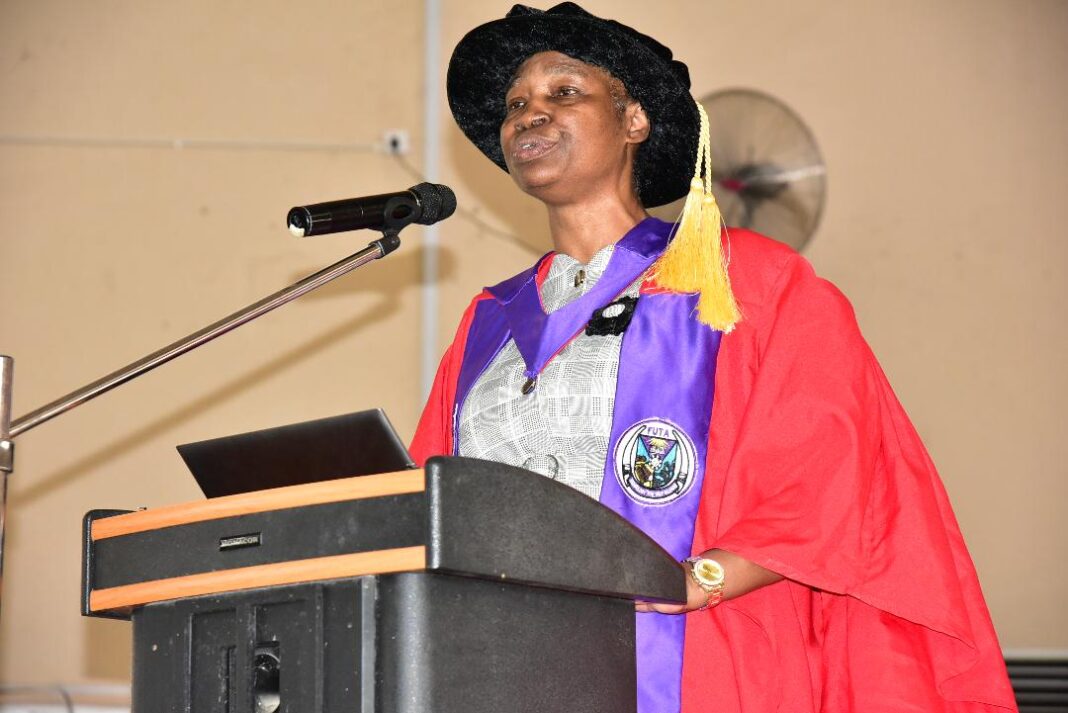

A Don at the Federal University of Technology, Akure, FUTA has stressed the need to develop a strong synergy between modern technology and the human learning process, including comprehension of concepts to improve knowledge quality and enhance institutional effectiveness. Professor of Intelligent Systems and E-Learning, Catherine Agbonifo of the Department of Information Systems, stated this while delivering the 207th inaugural lecture of the Institution on Tuesday, September 22, 2026.
Agbonifo, who titled her lecture, “Deep Knowledge Community: Triad of Anatomy, Dynamics and Pattern of Learning Principles,” recommended to universities and tertiary institutions the redesign of curricula to embed personalized, adaptive, and learner-centred digital pedagogies, adding that faculty training programmes should equip educators not merely as content providers but as architects of transformative learning experiences grounded in cognitive psychology, instructional design, learning analytics, and technological fluency. She said institutional policies should support interdisciplinary collaboration among computer scientists, educational technologies, psychologists, curriculum developers, and policymakers to ensure coherent implementation of learning technologies.
Dwelling on the conceptual foundation of learning and learning principles, the don said learning is the foundation of human development and educational practice. She added that it is the process through which individuals acquire, organize, apply, and transform knowledge, skills, attitudes, and competencies through experience, instruction, and interaction. She said the future of educational technology does not lie merely in developing more sophisticated technologies, but in developing more Intelligent relationships between technology and human cognition. According to her, “ The way forward is a shift from technology-centred education to learning-centred technology; from information delivery to knowledge construction; from uniform instruction to adaptive personalization; and from passive consumption to active participation.”
Professor Agbonifo urged educational stakeholders, including software developers, instructional designers, private sector innovators, accreditation agencies, and international organisations to adopt the Triad Framework as a foundational model for designing, evaluating, and deploying educational technologies. She said learning systems should integrate adaptive personalization, emotional responsiveness, collaborative engagement tools, and analytics-driven interventions that support diverse learner trajectories.
At the continental level, Agbonifo said, “For Africa specifically, continental collaboration through regional educational policies, shared digital infrastructures, and indigenous innovation ecosystems is critical. African governments and institutions should prioritize locally relevant educational technologies that address contextual realities while participating competitively in global knowledge economies.”
On the way forward, Agbonifo suggested that future research should expand the Deep Knowledge Community Framework through advanced AI, emotionally intelligent adaptive systems, neuro-educational analytics, mixed/extended reality, predictive personalized learning and blockchain-based credentialing. She said the overarching direction is to harmonise technological innovation with the enduring principles of human learning, creating equitable, culturally responsive, intelligent and sustainable learning ecosystems.
The don said her research, grounded in the deep knowledge community framework and its anatomy, dynamics and pattern of learning, has translated principles of human learning into innovations spanning cognitive architecture, adaptive sequencing, personalized and affect-aware learning, learning modelling, AI, educational data mining, virtual reality, and digital game-based learning.
In her opening remarks, the Vice Chancellor, Professor Adenike Oladiji, who chaired the event, described the lecturer as a distinguished scholar who keeps adding value to her field of study locally and internationally. She commended her efforts in churning out upcoming scholars who are blazing trails in society.