


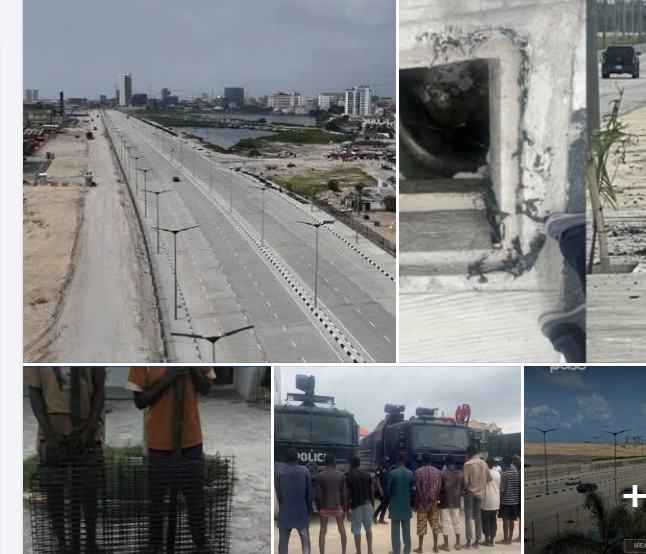

A great city is revealed not only by what it builds, but by what it refuses to let decay. The Lagos-Calabar Coastal Highway is more than a carriageway beside the Atlantic. It is a national wager on Lagos, a declaration that Nigeria still intends to build at continental scale.
That wager is already being tested.
Before the road has fully entered public life, vandals have removed kilometres of fencing and drainage covers. Solar lights, safety barriers and other public assets have become prey. Motorists meant to observe a 30 km/h construction-zone limit have reportedly travelled at up to 120 km/h. Trucks park where they should not; illegal U-turns appear; hawkers, motorcycles, tricycles and even grazing animals intrude upon a corridor designed for order, speed and national purpose. The Federal Ministry of Works has warned that the road could be closed if these violations persist.
Closing the highway would protect it temporarily. But it would also concede too much to disorder. A road of this consequence should not be shut because the state cannot enforce the rules that make it safe. It should be governed.
This is where Lagos State must step forward, not as a defendant in a federal complaint, but as a partner in the stewardship of a historic asset. President Bola Tinubu’s administration has placed an extraordinary piece of national infrastructure at Lagos’s doorstep. The State’s response should be gratitude in its most serious form: capable collaboration.
Lagos has institutions equal to the task. Its traffic-management capacity, Rapid Response Squad, Neighbourhood Safety Corps, environmental agencies and digital enforcement systems can reinforce the Federal Government’s Coastal Highway Guards. What is needed is a single operating compact: round-the-clock patrols, intelligent cameras, rapid incident response, automatic speed enforcement, tow-away zones for heavy vehicles and a visible zero-tolerance regime for illegal crossings, hawking and encroachment.
Closing the highway would protect it temporarily. But it would also concede too much to disorder. A road of this consequence should not be shut because the state cannot enforce the rules that make it safe. It should be governed.
The campaign must also go beyond the roadside. A manhole cover is not stolen for private admiration. Fencing is not dismantled without a buyer. Lagos and the Federal Government should pursue the criminal economy behind the vandalism: scrap dealers, metal aggregators and foundries that receive public infrastructure as raw material. The thief matters. So does the market that rewards him.
The State should take equal ownership of the road’s public realm. Drainage, landscaping, lighting, sanitation and coastal environmental management are not decorative concerns. They are the difference between a highway that merely carries vehicles and a boulevard that announces a city’s standards. Lagos should make this corridor secure, green, clean and unmistakably world-class.
The Lagos-Calabar Coastal Highway can relieve pressure on existing routes, open new logistics and tourism possibilities, deepen waterfront commerce and strengthen Lagos’s place as Nigeria’s principal gateway. But infrastructure does not automatically create civilisation. It creates an obligation.
This is not an indictment of Lagos State. It is an invitation to leadership. Nigeria has built Lagos a monumental gift. Lagos must now protect it, dignify it and show the country that public assets need not be surrendered to neglect the moment they are born. Indeed, this should become the template for collaboration: every coastal state touched by the highway must help to protect, maintain and elevate the national treasure within its borders.