


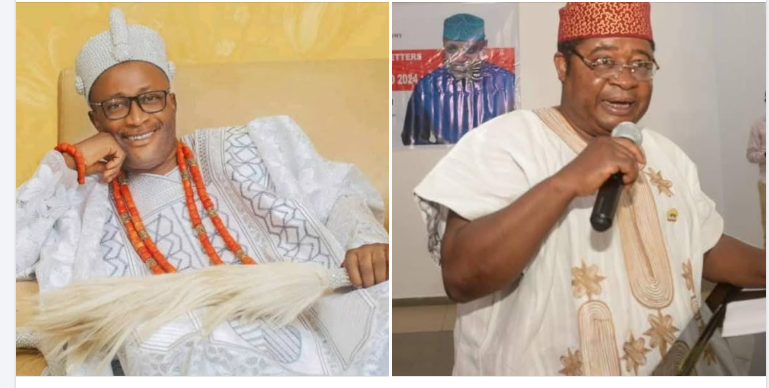

After weeks of mourning the untimely departure of Kabiyesi Oba Adebanji Alabi Afuntade — an extremely pleasant personality I had shared moments with long before he mounted the throne of his fathers — I have gradually pulled myself together to write this tribute as a witness to the character of a man I knew up close.
Oba Afuntade was a humble prince who became a compassionate king. A genuinely kind, simple, and loving fellow, he was never swayed by power, position, or personal accomplishments. My relationship with him further taught me the needless nature of arrogance. In terms of personal achievements, the sweet prince, long before he became king, ought to have been a study in self-recognition. But he chose the path of uncommon humility and related with those who knew him with an abundance of respect and love.
I first met him in August 2003. I arrived at Norman Manley International Airport, Kingston, Jamaica, to the waiting hands of the Nigerian High Commission staff who were there to ferry me to the High Commission in Waterloo. The team that came to the airport was led by Oba Afuntade, who, at that time, I didn’t know was an Ekiti prince — a prince of Ilawe-Ekiti, the town where I spent five years of my life as a secondary school student.
He simply introduced himself to me as Mr. Banji Alabi and said the then Nigerian High Commissioner in Jamaica, Ambassador Nike Ukonga, had sent him and two other staff members to bring me to the office. Then came the first shock: he directed his subordinates to carry my light luggage — a midsize box and a small backpack. This “unknown” prince, a deputy director and career diplomat at the time, himself reached for my very heavy Ghana-must-go bag where I had kept the African drums I brought for my assignment in the country. He lifted the heavy bag and its contents, placed them on his shoulder, and we began the long walk to the parking lot where a bus was waiting for us. On our way to the office, I asked him why he had to carry the heavy load himself when his subordinates were there. He answered me in Yoruba: _Eeyan naa niwon_, meaning “They too are human beings.” I was shocked.
At the High Commission, it was discovered that the Jamaican Ministry of Arts and Culture, my official host, had secured my accommodation, but I would still need an office — a workstation where I could do some personal writing after teaching sessions across Jamaican dance schools and troupes. This prince, whom everybody around thought was just Mr. Alabi, quickly offered to share his office with me. He personally carried an extra table and chair to his office, and for 60 days we operated from that office together.
But the biggest surprise was that he never told me he was a prince. He never lived like a prince. For sixty days, we lived together doing ordinary things. We strolled together to buy barbecued meat. We went together to the Little Theatre and the Ward Theatre in downtown Kingston to watch performances. Some days he asked Desmond, my driver, to rest and personally drove me to my places of assignment. He convinced the High Commissioner to pay me for an added engagement to train all the children of Nigerian diplomats in Jamaica and use them to establish the Nigerian Dance Troupe, Jamaica. His house became the rehearsal ground, and all his children were members of the troupe. That troupe had its first public performance on October 1, 2003, at the Nigerian Independence ceremony in Jamaica.
The moment he later discovered that I was a fellow Ekiti man, he started speaking undiluted Ekiti to me. He lured me into my first experience on a flying boat. It was a Saturday morning. He took me to Falmouth for a boat ride. He literally bundled me into the flying boat after paying the operators. I was scared! I recited all the books of Psalms I could remember before the end of that ride.
In early November 2003, the humble prince drove me back to the airport in the company of Jamaican authorities. This time, my luggage was a lot easier to carry. The prince had bought all the drums for the new Nigerian Troupe I left behind. We shook hands at the airport and exchanged pleasantries. Still, he never told me that he was a prince. No mention of his link to royalty.
It was therefore a pleasant surprise when, at the first convocation ceremony of the Federal University Oye-Ekiti in 2016, as I was inspecting the placement of technical equipment by some vendors, a voice called my name from behind me. I turned and saw an Oba dressed in splendor. I knew I had heard that voice before. I also knew I had seen the face before, but the interplay of the beaded crown with its dangling accessories would not allow me to see the face clearly. He understood and said, “It’s me, Mr. Alabi from Jamaica!” I forgot he was in a sparkling white robe. I jumped on him like a young footballer who had just scored a goal.
From that day, we revived our relationship, visiting him and staying close to him. Happily, I discovered that he had not only become more humble; all his positive traits were intact and sustained. I was therefore devastated by the news of his joining his ancestors so soon.
This is one good tree that should have stayed long in the forest. This is one true servant-leader whose service death has denied us. Oba Adebanji Alabi Afuntade still had a lot to offer us, but death — the enemy of good things — has snatched the good man from us.
Farewell, Kabiyesi. We have beautiful memories of you, and they live on in our hearts.
*Prof. Rasaki Ojo Bakare, former Dean, Postgraduate School, FUOYE, is Ekiti State Commissioner for Arts, Culture and Creative Economy