


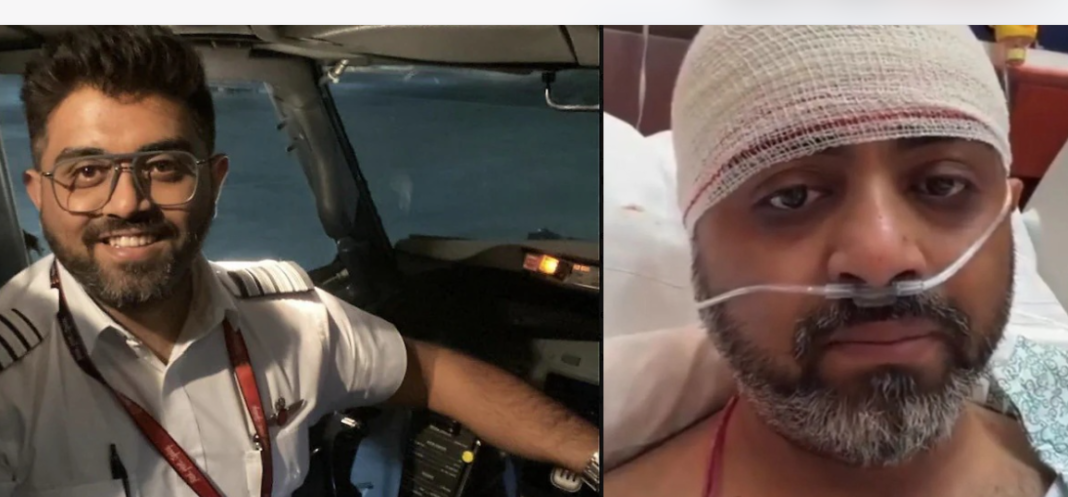

The pilot of the hijacked Israel-bound plane has revealed how he managed to open the cockpit door and alert cabin crew to the attack while lying on the ground with severe injuries.
Smit Machchhar said he was “not going to let others die” and opened the door to save the 174 people on the flight from Dubai to Tel Aviv.
Passengers on the Flydubai flight were sent into panic as the plane nosedived 17,000ft during the stabbing attack by the Omani co-pilot before four of them overpowered him.
The plane landed safely in Saudi Arabia, and Mr Machchhar has since been transferred to a hospital in the United Arab Emirates (UAE). There, he held a video call with Narendra Modi, the Indian prime minister.
Speaking from his hospital bed for the first time since the incident, Mr Machchhar said: “I was lying on the floor injured, but I told myself to go for one last push to open the door from inside.
“Others came in and also played a role [in controlling the situation]. I was of course fighting for my own life, but at the same time I knew I was not going to let others die.”
Benjamin Netanyahu, the Israeli prime minister, confirmed that the co-pilot, who has not been identified, had been arrested and was being questioned.
The pilot was previously prohibited from flying in Oman over concerns he had become radicalised, it has been reported. The Wall Street Journal claimed the Omani co-pilot had been banned over his radical ideological views before he was hired by FlyDubai.
Mr Machchhar was seen with bandages on his head and hands as he spoke to Mr Modi from his hospital bed in a clip released by the Indian prime minister.
Holding back tears, Mr Machchhar said: “I knew that the aircraft was going down. I had fallen to the ground. I told myself that the door is right there, just open it. I managed to do it, and people entered.”
Mr Modi hailed his “courage, patience and quick decision-making [that] saved the lives of so many people”.
The Indian prime minister also said Mr Machchhar’s actions reflected the spirit of Indians to protect others, saying: “The entire country can proudly say that we Indians are not people who take lives; we are people who save lives.”
During the interaction, Mr Machchhar told Mr Modi he “was fighting for my life”.
He said that after he fell to the floor owing to his injuries, he realised that the aircraft was going down.
“I have been a captain for the last 11 years. And I get to know, even with my eyes closed, what is happening in the aircraft. When I had fallen down, then I was feeling that the aircraft was going down,” he said.
Mr Machchhar said he realised that there were only a few moments left and pushed himself to reach the cockpit door, explaining: “And even then, I was trying to crawl. I opened the door, and rest came.”
He also expressed gratitude to the Saudi and United Arab Emirates authorities for the medical treatment and assistance provided to him.
Mr Machchhar described Mr Modi as his “biggest idol”, adding: “I feel proud of the way you are encouraging me today.”
Hero’s hand ‘almost cut in half’
The stabbing took place at about 9am. Four passengers, including off-duty pilots, overpowered the attacker and made the emergency landing.
Footage shows Mr Machchhar shirtless and clutching his chest with bloodied hands, while an oxygen mask covers his mouth. Video from the cockpit showed two pilots wounded and bleeding. The pilot and co-pilot were both taken to hospital.
On Thursday, Donald Trump described the attacker as a “possible whack job” and suggested he might have links to Iran.
The US president said he was “hearing” Iran was involved in the hijacking, adding that the Islamic Republic would be struck “very hard” if so.
When asked by reporters whether he had been briefed about links between Tehran and the pilot behind the attack, Mr Trump said: “I would say the answer, based on what I’m hearing, is yes, but we’re working on it right now.”
“Oh, they’ll be hit, very hard, don’t worry,” he answered when asked whether the US would retaliate.
Mr Netanyahu warned a “very heavy price” would be paid by any power that had sent the attacker, without elaborating on any country. He added the attacker “underwent Islamist radicalisation”.
Meanwhile, Anwar Gargash, a UAE presidential adviser, called the incident a “terrorist act” on Friday.
Praising Mr Machchhar, Mr Gargash said he deserved “every appreciation, for in confronting a serious terrorist act and a potential disaster, he embodied the true meaning of courage and responsibility”.
Israel and the US have linked Iran’s Shia clerical state to numerous attacks around the world since the Islamic Republic was founded in 1979.
But it has little known connection to hijackings, the hallmarks of Al-Qaeda during the 9/11 attacks and the Popular Front for the Liberation of Palestine in the 1960s and 1970s.
According to witnesses, the attacker begged for passengers to kill him as he was being restrained, suggesting it was a suicide mission.
Passenger Yaniv Hayun, 50, was one of those who restrained the attacker. He managed to pull the jet’s steering control to stop it plunging into the ground.
An experienced pilot on board then took control of the aircraft and landed it safely in Saudi Arabia.
Mr Hayun said he knew how to stabilise it after watching many episodes of Air Crash Investigation.
Lital Shahar, who was on the flight with her four daughters, said she began praying and told her daughters: “We are in God’s hands… we have to stay strong.”
She recounted sitting in a row with them and did not know whose hand to hold first.
“It was a crazy moment, really horrifying situation,” she told CNN.
Mr Machchhar had suffered severe wounds to his neck and his left hand had almost been cut in half, a dentist who treated him on board told Israeli army radio.
Shota Musaev told the station that the captain’s pulse had begun to drop as he drifted out of consciousness, prompting the off-duty pilots to land the plane in Saudi Arabia, which may have been crucial to Mr Machchhar’s survival.
“I don’t think he would have survived all the way to Israel,” Mr Musaev said.
Mr Musaev added that Mr Machchhar had spoken about his children and had asked to be saved while he bled on the galley carpet.
The attempted hijacking was not Mr Machchhar’s first emergency as a pilot.
The experienced captain once had to reroute and land at a different airport after a passenger went into labour shortly after take-off.
The Wall Street Journal reported that Mr Machchhar, who lives in Dubai with his wife and two children, had 13 years of experience and was known to his friends and associates as a sober and grounded pilot.
However, becoming a pilot was not his first ambition, he told the Bona-Fide Banter podcast last year. Instead, he expected to join his family’s business and studied textile engineering and management.
But after attending a seminar on aviation, he decided to change paths and train to become a pilot, with the aim of working on Boeing planes.
Mr Machchhar trained in New Zealand and started working for a low-cost airline called SpiceJet.
His interest in Boeing planes – which he has flown for around 9,750 hours – was dampened in 2018 and 2019 following two fatal crashes on the model he had trained on.
“That’s when panic started. We were not scared, but we were not sure what was going on at that point,” Mr Machchhar told the podcast, adding that he was later reassured by safety fixes.
He would go on to deal with in-flight emergencies – such as a passenger suffering from shortness of breath and a surprise labour.
Teena Goswami, a fellow captain, described her former colleague as “very cool-headed, very calm”, attributes which helped him during Wednesday’s attack.
* Lily Shanagher, Foreign Breaking News Reporter and Samaan Lateef, Foreign Correspondent wrote this piece for The Telegraph