


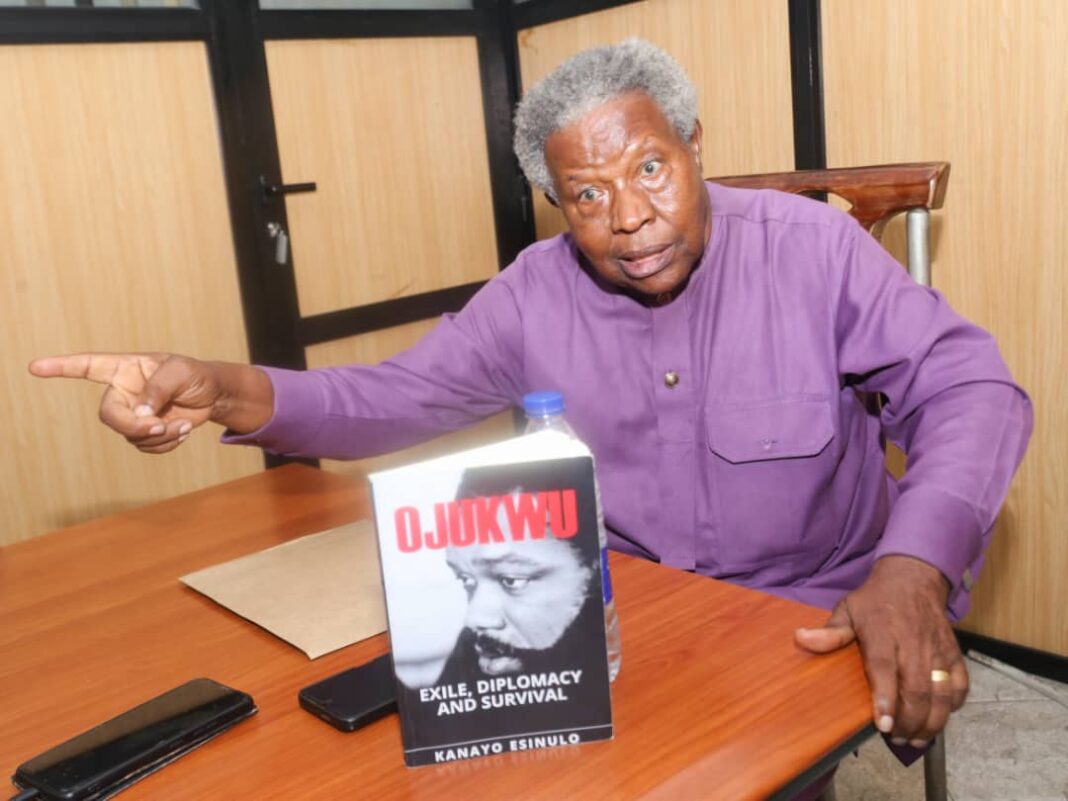

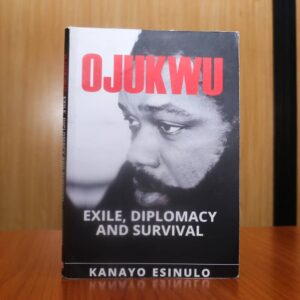
Mr. Kanayo Esinulo, veteran journalist, who will turn 78 in September, wrote a book, ”Ojukwu: Exile, Diplomacy and Survival” (published by Eminent Biographies). It provides a detailed, firsthand account of Chukwuemeka Odumegwu Ojukwu’s 12-year exile in Côte d’Ivoire following the collapse of the Biafran struggle. Esinulo, who served in Ojukwu’s State House and followed him into exile, covers the diplomatic efforts, survival strategies, and eventual return to Nigeria in 1982.
In this interview, he spoke on the book, what prompted it, how he came in and out of Nigeria on errands for his principal, his detention in Kirikiri, and other issues.
Congratulations on your book, “Ojukwu, Exile, Diplomacy, and Survival”. Tell us when and how you finally decided to write this Book?
The pressure, at a point, became too much. There were certain events or occurrences that I needed to check and crosscheck before putting pen to paper. Again, I decided from the beginning that there will be no single falsehood or exaggeration in the Book. None. There will be no single hearsay in this Book. None at all. That Professor Wole Soyinka was the first Nigerian to visit us in Yamoussoukro is empirical. Wole is still alive. I sent a copy of the Book to him through Dr. Ogunbiyi at GRA, Ikeja. So, to answer your question more directly, it was when I decided that I was ready and the conditions were right that I began the writing.
There were many things I had to discard or ignore. But generally, 95 per cent of Emeka’s days in exile were all captured here. We tried our best, after rigorous editing, to make sure that Emeka’s life in exile, the pressure put on him by the circumstances of his exile, were captured.
I began with how Houphouet Boigny began to rehabilitate him, and he rehabilitated him carefully and with deep interest. That was why when Houphouet died, and some of us stayed here and were writing beautiful prose, there was no representative at his funeral. There was none in Abidjan or at Yaomousokro, his hometown. Who told me? Emma Ackah. Emma Ackah was seconded from the presidency to Emeka.
So, if we wanted this, your bottle of water, and other things, Emeka would advise that a memo be done, Emma Ackah would pick it up and our needs would be met by the Presidential Kitchen. But, I think that Adinuba replied that some were actually there to pay their last respects.
I can say that this Book is a product of pressure. “Kanayo owes us a book. These snippets in the newspapers and magazines, TheNEWS magazine, are certainly not enough. You have to give us a Book.” And that is the result of that pressure.
How did you come about working for Emeka in the first place?
I was a staff member in Government House, Umuahia, and then we moved to Madonna 1 when Umuahia came under siege. it was from Madonna 1 that he left, and we all left. Those who were close to him, those who were able to secure spaces in the aircraft. Because there were about four or five flights that day. That’s how.
During the war?
As the war was concluding, we had lost 12 Div. Ops Area. 12 Div had lost their area. If 12 Div did not lose its area, that’s what we call it in Biafra; the war couldn’t have ended when it did. Colonel Tony Eze abandoned what he could have done, his colleagues openly said. He and his men didn’t put up a good resistance. And don’t forget that three West African countries were in the mood to recognize Biafra by January 1970. That one I can tell you authoritatively. I have said it elsewhere. I have said it at such a gathering in Houston, U.S., during an interview on Live Television. I was interviewed by many American networks when I was in Houston late last year.
Which countries were those?
Sierra Leone under Siaka Stevens. Busia was in the mood. The third one was Senegal. Sedar Senghor.
Sedar Senghor was very reluctant. Chinua Achebe went to see him. They talked for days and the result of the talks yielded the promise.
But, you know, Senghor did not give him any opportunity. Eventually, that promise came. Not through Chinua. Chinua sat there in Dakar putting enough pressure. He kept Chinua in the hotel for about two weeks. And Chinua was running out of cash. Eventually, he made a firm promise that if Biafra was able to cross the January 15 date, Senegal would make an important statement. Sierra Leone and Ghana, under Busia, were also in a similar mood. And they had given us a condition. Which I mentioned in the book. “If you can survive till January 15, 1970, we will recognize you.” But by January 2, 1970, we had lost vital areas in the Aba area.
It still invites tears when some of us remember what happened. Because the Okigwe sector was stabilized. They couldn’t move beyond Asaba. The remnants that entered Onitsha were stranded. So we were hopeful that we had stabilized. We were just waiting for diplomatic… And 12 Div collapsed. By the time we were waiting for them at Azumini, they had crossed to Aba. By this time, the present-day location of Sam Mbakwe Airport at Owerri was already threatened; who else would tell Emeka to move? And he doesn’t disobey him. Sir Louis. Sir Louis told him, I think we’ve tried. And don’t forget again. Sir Louis was the only justice who wrote the minority report on the sentencing of Chief Obafemi Awolowo. Don’t forget that.
Are you talking about Sir Louis Mbanefo?
Sir Louis was the only Supreme Court justice who said… Ten years for doing what? And I will link that up with… From Calabar prison, released by Yakubu Gowon. And he came to Enugu. Emeka sent vehicles to bring him to Enugu, General Ojukwu told some of us in exile. It was from Enugu that Awo was flown to the West – Ibadan and Lagos. It was Sir Louis Mbanefo who received him officially. People say, Ah, Emeka received him, and after he held a meeting where Awo said if the East was allowed to go, either by act of omission or commission, the West will also go. I wouldn’t know beyond that. But I do know for sure that the person Emeka detailed to receive Chief Obafemi Awolowo from Calabar prison was Sir Louis. Whether it was strategic, political, or ideological, I don’t know. But he received him officially on his behalf.
Can you give us an insight into the workings of the decision-making body during the civil war?
I’m not in a position to do that. I was not positioned to know. But in exile, I can answer that. During the war, his official advisor Dr. Kalu Ezera. Kalu Ezera was killed after the war by a Nigerian soldier who was in search of fame and promotion. It was sad news for him in Yamoussoukro. The war had ended. He killed one of the first-generation political scientists in Nigeria. He was head of political science at Nsukka. Pre-war. And he was heading to his village at Ohafia. That’s all. We lost him. Am I going to mention how many innocent people that we lost in similar circumstances after the guns had gone silent. The war had ended. Dr. Ezera was going back to his village when an ambitious Nigerian soldier who was angling for fame and promotion shot and killed him in cold blood.
Now, you left Nigeria in that aircraft, maybe about three or so, as you said. You were just in one of the aircraft. Where did you land? Tell us the story. How was the reception like? And how were you, you know…
Houphouet was in Cameroon. He wasn’t in the country. He was on a state visit to Ahidjo’s Republic of Cameroon. And the information reached him that Biafra had collapsed. He cut short the visit and came back. And received a guest. Don’t forget that he was daily briefed on the situation at the war fronts. Houphouet was not just a friend of Biafra. He was a committed friend of Biafra. So was Siaka Stevens. So was the one who disappointed us later, Albert Bongo. They were all committed to the liberation of eastern Nigeria from…
Why were they so committed?
They saw the genocide. They saw the killings. They saw the brutalities in the north. And it’s not this one that the American president is talking about, Christian genocide. The killings then were massive. These countries were properly briefed. Take somebody like Julius Nyerere, for instance. Julius, at his own level of intellectualism, at his own level of Pan-Africanism, knew what happened. And that was why he was the first President to recognize Biafra. I tried to include his letter to Emeka justifying his decision to recognize Biafra. It’s not in the book because I couldn’t lay hands on the copy. But I know that in exile, Julius was in touch with him. Kenneth Kaunda was also in touch with him. We later quarreled with the man in Gabon.
What caused the quarrel?
Bongo appropriated monies favourable to Biafran accounts. Why do you shut down accounts that were still running? Even after the collapse, after Emeka had left Biafra for exile, there were still people who were committed. They had said, this money we are sending is for you to try to find a way to send relief from there through existing Committees. We have urged the international community to ensure that starvation did not take its toll on human life in the beleaguered territory. But as soon as those monies were coming, the man in Libreville became greedy. And that caused some friction. In the little position where I was, I knew that there was a problem. But he maintained personal relations with Kenneth, with Julius, with Houphouet, and with Baba Doc.
Did he visit with any of these people at any point?
Oh, no. No! The condition of his exile was strict. Don’t politicize. Don’t let the world believe that there is a base for the destabilization of Nigeria. But I do know that Ali Simbule visited us. We needed that visit. He visited Yamoussoukro. Who is Ali Simbule ? Ali Simbule was the man who described Britain as a toothless bulldog. Which it is. He was the Zambian High Commissioner of what you call an embassy, the Zambian Ambassador at the Court of St. James’, the Zambian High Commissioner to Britain. And when UDI, Unilateral Declaration of Independence, was declared in 1965 by Ian Smith, Zambia expected UK to respond to the rascality of Ian Smith. It didn’t. That motivated Ali Simbule to issue that statement, saying that Britain is a toothless bulldog. They gave him 24 hours to leave the country. He was received at Lusaka Airport like a hero. That was in 1965. In 1968, he visited Biafra. And he stayed for three weeks or so, not sitting down at Government House, Umuahia or what you call State House and Aso Rock. Uche Chukwumerije, Eddie Iroh, and the rest took him to the critical war fronts.
So when at a press conference, before his departure, Ali Simbule said, and I quote him, “Before I came to Biafra, I was told that Biafrans fight like Heroes. Having stayed here for some weeks and visited so many war fronts, I can now tell the world that Heroes fight like Biafrans.” He visited us in Yamoussoukro. No person knew what they discussed. Emma Achah and I were excluded from that meeting.
Why?
Simbule said he came with a personal message from Kenneth. Kenneth Kaunda was already suggesting that Emeka should be thinking of going back to Nigeria. He muted the idea. The battle for him to come back was not easy. There were still those who didn’t like him as a person. They were insinuating that he was thick-headed and rebellious. That was their silly opinion, to which the ugly few were entitled.
He came back to Nigeria in the early 50s and applied and got a job as an Assistant District Officer, ADO, with the Eastern Nigeria Public Service under colonial rule. His father, Sir Louisasked: Do you know how many companies I have? You know how many branches I have? Emaka said, No. That was the origin of that his sentence that he said came from nowhere particularly: “All my life, I’ve been pursued by fingers pointing at me as Ojukwu’s son. I want before you die for fingers to be pointed at you as Emeka’s father.” And it happened. He never worked in any of his father’s conglomerates. And he told some of us, younger people like us, why he liked the public service. That was why his first job was ADO at Udi. Emeka Enejere, whose name featured prominently in my Book, was, in 2006, handing over his daughter in marriage. Obinwa Nnaji and I hired a Taxi to take us to Ibagwa-Aka for the Traditional Wedding. I told the driver, I was sitting in front, I said: “When we get to Udi, make you tell me.” He said, We’re already in Udi. I said, Udi is 2006? Udi is still rural beauty like this? So I can imagine how Udi was in 1950s, when Emeka was ADO. That’s his life, life of sacrifice. When the driver said, We’re already in Udi, I was shocked. I told myself: So, this where Emeka was in 1950s. It was from there they transferred him to Aba. He said from Aba, these colonial people, wanted to transfer him again to Calabar. And the father said, “Mba, Mba Calabar? Those beautiful women of Calabar will kill my son (laughs). That was why he wasn’t transferred to Calabar. He stayed on at Aba, and from there he joined the army.
Now tell us about these years of exile, how you settled down, what you did to settle down, and how you survived?
He survived because he had three companies that were flourished. Three that were at a particular point employing over 900 with 102 white people – Dutch, Belgians, French, and Americans. I’m not talking of local staff. I’m not talking about Ivorians, Guineans, Ghanaians and Nigerians. Some of the skyscrapers you see today in Abidjan were constructed by SERECI, his company. It’s in the Book. Phoenix Africaine, as his big Transport Company. Another big employer too. If Kunle, or Editor Demola were constructing in any part of Cote d’Ivoire, Emeka company Phoenix would move in and supply all the sands needed for that construction, if approached.
I’m not talking of road construction. I do know that the big hotels, skyscrapers, some of them 23 floors, Emeka’s company, Sereci, constructed them. Why? His contracts were coming from the presidential table. He had government sympathies and support. And like his father, he never failed to deliver.
I learnt that he was into transportation, as well.
He was into transportation, which is Phoenix Africaine that I was talking about. Sereci was into construction. Buildings and roads. Then the third one was Dow, D-O-W. He was into hiring and leasing of aircraft. Kunle’s son wants to wed, for instance, and people would want to charter an aircraft to lift them to the town/country, DOW would be available… The aircraft would be made available ant they will take them there. Emeka succeeded as a businessman there because he had all the sympathies and support of many Ivorians and the Presidency. He wanted to come home because of our people. Not that he was feeling uncomfortable in Cote d’Ivoire. No, he wasn’t. He wasn’t. He was at home because the Presidency, the Ivorian Business Class and the political elite found hardwork in him.
Dr Felix called him Mon Fils,. My son, I think he knew his father, Sir Louis. His father was fairly known across Anglophone West Africa. When the Ghanaian editors called me and said: “Kanayo, we want to visit and interview your man? I hinted it to Emeka. He said, why not? The Ghanaian press has been sympathetic to the Biafran cause. And of course, they knew that Aburi was a critical point in our efforts to reconcile with Nigeria and to avoid further cleavages. And it all happened at Aburi. So, I understand why they are interested in securing an interview. Bring them over,” I told Osei Poku and Osei said, is His Excellency inviting us? I said YES! At this point, I briefed Emeka on phone because I was in Accra on errands. Emeka sent money for the air tickets. It is all there in this Book. Later, Osei told me that he couldn’t move that number of editors out of the country without clearance from Ghna’s Security. I told Emeka of this new development that evening on the phone. Like I said, I was in Accra. I told hm what Osei just told me. He said Osei was right. Twelve senior editors, including T.B Oti insisted on clearance. He was the Managing Editor of Ghana News Agency, GNA. He couldn’t have moved that caliber of Editors out of the country without telling intelligence. So Osei cleared with the Ghanaian intelligence. Even when they queue up to board the aircraft, their presence alone will generate interest and curiosity. So, that’s how I took them to see and interview General Ojukwu. They stayed for five days interacting with their Chief Host. During one of the interview sessions, Emeka recognized the face of one of them, Emmanuel Banns. He recognized Emmanuel Banns. He said to him:, “You came into Biafran in 1968. Am I right? He said, Yes, Your Excellency”. One of them said, General, you can recognize faces. He said, I still can recognize the faces of those who braved it to visit us in Biafra, in the midst of the war. I still can recognize some of the faces that came to interview me. The African ones, he meant, not the Swedish, Norwegians, the Americans, The French and the British.
So, apart from his business enterprises what other things would you ascribe to his survival, for him and your team?
Emeka was part-time Lecturer. He was a part-time lecturer in a school in the US. I’ve forgotten the schools now. He was also a part-time lecturer in Paris.
But was he traveling there.
Oh, yes. He was traveling. A letter I published in my Book read: “Kanayo, I will be away in Europe for about two weeks”.
Were you writing?
Occasionally, I wrote a column for Accra evening News. But I was always on the move. Few writing but always on the move. Fewt writings but more of Movements.
You were sneaking to Lagos, everywhere.
Yes. It’s in the book.
Was that what culminated in your arrest by the Gowon regime?
What motivated them to arrest me was I came in to deliver certain important messages to the Amayanabo of Bonny, King Pepple. And from Nigeria, I moved into Togo. The Amayanabo of Bonin accompanied Chukwuemeka Odumegwu Ojukwu to Addis Ababa for peace talks. So, when our colleague Ed Obilo, interviewed me and early last year, 2025, and asked same question. I answered by asking: “Why should Governor Diette Spiiff prevent the King from going home to his Bonny Ancient Kingdom? Why shouldn’t he enter his Rivers State? The war had ended. Every other person had moved into Port Harcourt to migrate to their villages. Why was he preventing this King from going back to Bonny? He went in for two weeks and they gave him order to leave. It is in this book that they are now quoting, outside this country, that Ukpabi Asika Asika rehabilitated him. Yes, Ukpabi did and the King told me so and I conveyed this gesture to Emeka in Yaomousokro. Ukpabi Asika got it so right there. And Emeka was happy with him. Why was the Amayanabo of Bonny singled out and prevented from going into River State? Did he follow Emeka to Addis Ababa to recruit soldiers? Did he follow Emeka to go and recruit pilots? Did he follow Emeka to go and buy arms and ammunition? No. And those who followed the war diligently knew that the nearest way that ever came to ending that war was by Negotiations and in 1968, Addis Ababa offered us the unique opportunity. The peace talks in Kampala, Uganda, the peace talks in Naimi, Niger Republic, played their own historical parts, but the most serious of them all, was the one organized by OAU in Addis. And Emeka arrived the Ethiopian capital with our First Eleven.
Not the one in Aburi?
No, Aburi was pre-war. So when news reached Emeka that Dappa Pepple, the King of Bonny, was not allowed into River State, Emeka tried to find out how was he managing? He had lost a kingdom, he had lost Resources and his health was going bad in Enugu. The news reached us that Ukpabi i Asika, the then civilian administrator of East Central State, was taking good care of the now exiled King, He eventually died in 1972. I came into Nigeria to meet him several times from Yoamousokro. The son is now the King. And don’t forget that all these LNG, all these companies in Bonny know and recognize that the Amanyanabo is their Landlord. That is their culture. So, Addis Ababa peace talks were, to me and to many, the nearest we came to a peaceful settlement. But it failed.
Talk about your arrest.
Enejere was a smooth operator. Before boarding for any flight into Ikeja Airport from abroad, Emeka would tell me on phone to hold a white handkerchief on my left hand or some other forms of identification. Once the immigration or customs officer sees somebody with white handkerchief on his left hand, he would simply come over and say: Kanayo, right? I would say Yes? Enejere was such a fantastic Leader and Director of Operations. But at a point, he had to leave because of our inability to establish a newspaper in Lagos through surrogates, as planned. We wanted to establish a newspaper in Nigeria in 1972. So because of the failure of that project, Enejere angrily left. In the Book, I described in detail why he left.
But, he didn’t just leave. He left for the University of Washington in US. That was my last defensive position. So when I entered Nigeria without Enejere’s guidelines and outside his protective umbrella, and smooth hotel arrangements, the people I would meet, where I would meet them, those basic arrangements were no longer there. So I became vulnerable. And I was to proceed to West Germany from Lagos, General Ojukwu had found me a school in that European country. I was heading to Frankfurt. Actually, my flight was Accra/ Frankfurt. But because I had overstayed here in Nigeria, my handler caused my air ticket to be reorganized to now read Lagos/Frankfurt, instead. It was while on my way to Frankfurt for that journalism training that one young man came. Are you, by chance, Mr. Kanayo? I said Yes Have you checked in your luggage? I said, Yes. Please, if you don’t mind, can you identify them for me. I pointed them out. And I said, what is happening? He said, I will tell you later. So he retrieved the two luggage. And the trip was aborted. So from the airport to Moloney Street, then police headquarters. From Moloney Street to Alagbon. From Alagbon to Kirikiri.
And you spent three years in prison?
Three horrible years under rigorous solitary confinement. Yes, I had graduated from the School of Journalism in Accra. And Emeka had found me a job. Emeka had also found me a school. I said, No, I prefer School first. Let me advance my training. It was on that trip that they stopped me.
By that time you only had your school certificate, right?
No. I had left School of Journalism. I had graduated.
In Accra?
Yes In Accra.
Now, talk about your experience in Kirikiri?
It is captured here in my Book. Terrible experience. To a point where this same Wole Soyinka (mention it to him) alerted Amnesty International. They said, no, he hasn’t done anything wrong or threatening to the Nigerian State. Amnesty International stood behind me. The International Association for Cultural Freedom, IACF, was behind me. The United Nations Human Rights body got involved. United Nations Human Rights Body. But Yakubu Gowon was adamant. So when it was decided that pleading would not solve this problem, Gani Fawehinmi came in. That’s why this book is dedicated to Gani Fawehinmi. That was what some, I won’t say bigots, some interesting human beings, were asking me in US, “Kanayo, why should this book be dedicated to a Yoruba man?” I said, when you read the book, you would understand why. Gani is not a Yoruba man. I told them, inside a big conference Hall like this, They were more than 50 Nigerians and people of other nationalities in that Hall that day. Gani is not a just Yoruba man, I repeated. He’s a Nigerian, a thorough human being. And I wrote in the book that for the first time, my uncle – my father’s junior brother – was tlo travel beyond River Niger to come to Lagos to see me at Kirikiri, Apapa. He hadn’t been to Lagos ever before. And after he perched around some lawyers and some legal chambers in Lagos, each kept referring him to Gani. Eventually, he was able to locate the Surulere legal Chambers of Gani. And after briefing him, Gani asked him when he planned to go back to the East? My uncle, Chief Ernest Esinulo, said, ‘Tomorrow Sir” Gani said: “I will pay for the transport back to Aba. The fare was 30 Naira then. He gave him enough cash for the fare and other incidentals. And told him: Leave everything for me, but come to the Chambers in Surulere and sign some necessary papers. He met Gani at a court premises. Within a short time, Gani secured a writ of Habeas Corpus for July 29. I was to be brought physically brought before the erudite Justice Michael Odesanya’s court. It was on July 29 that I was supposed to come physically before him. And on. July 29, I got up by 5-30am. The warders brought hot water for me to bathe. By 6am, they told me that the vehicle that would take me and some warders to Odesanya’s High Court was ready at the Main Gate. By about 6.35am, the news started spreading that Yakubu Gowon notorious regime had been overthrown. Oh, yes. If you look at the book, there’s a place they said, “Produce Detained Newsmen.”
And in this story and in my Book too, you will see that I was supposed to be there on July 29, 1975. It was while preparing to go to court, in obedience to the court order, which Daily Times … Daily Times s was an important newspaper – influential and authoritative – had carried on its front page. While I was preparing, one of the warders said to me: “Ebee like say, we no go go that court again today.” I said, Wetin happen? Gani would be disappointed. They said, No, No, No be Gani matter now, the seat of power has changed. Yakubu Gowon had been overthrown. Gowon’s propensity to detain Citizens without trial had consumed his notorious regime, I said to myself and to the two Prison Warders.
Are you still angry with him?
Yakubu? Yes, if he enters this your office now, I will not get up in reverence. I will not shake his hand. I will not, Gowon was brutal and was aided and encouraged by characters like Alhaji Kam Salem.
I was going to ask you about when you felt enough was enough in exile. At what point did you and Emeka himself begin to think that it was time to go home? And what were the prompters? What triggered that?
What triggered that? While I was studying in The Netherlands, Emeka was passing through Schipol Airport. There’s a letter published in the book where Wole was saying, “I was unable to meet you in Accra, but it is now more likely that we’ll meet in The Hague. The letter is in the Book. Emeka made the same promise. We couldn’t meet but Emeka suggested very strongly that I should spend my long vacation in Bingerville. I was in The Hague pursuing a Master’s Degree. I was trying to argue but Emeka insisted, saying, “Is it not air tickets? Kanayo. are you paying for the tickets? What is the Problem here? After three or so days, you go back to The Hague. Emma should be able to arrange that.” So I got Lufthansa ticket and moved to Abidjan. I was picked up by Emma Ackah . General Ojukwu then told me that Emeka Enejere may likely join us at the meeting in Bingerville, Cote d’Ivoire. But Enejere was unable to make it. It was at that meeting that the General revealed that he was tired of exile and that we needed to repackage. Luckily that year I was graduating. So, we shared responsibilities. That was why I moved straight to Cot d’Ivoire from Amsterdam Airport to Cote d’Ivoire after my studies at The Hague. There’s a letter of admission from University of Lund, in Sweden in the Book. Wole encouraged me to accept the admission for a Ph.D at the University of Lund Sweden.was interested in that school and was encouraging me because it is a good school. Wole was one of my referees on the Application for Admission form. The Letter of Admission was signed by Prof. Rune Persson. It is there in the Book. But all this were overtaken by all the elaborate plans for General’s home coming. Emeka’s hunger to end his exile enveloped, eclipsed every other project. When I casually showed him the Letter of Admission from this prestigious school in Lund, Sweden for a Ph.D, he shot it down.
He wanted to go home, was his new focus. Weeks later, works on ending his exile began in earnest. We started firing from all available cylinder: Gbolabo Ogunsanwo was firing from the Lagos, Ibadan media axis. Obinwa Nnajii was firing from Enugu/Aba/Calabar media houses. Gbalabo’s Memos to me are contained in the Book. “Kanayo, what is happening to you? I have not seen or heard from you ever since… Please report at my house unfailingly tomorrow. I will be there by 6.30 in the evening. Or early in the morning at home at No 3 Remilekun Crescent, Surulere. That’s where we were meeting. He lived a quiet and simple life, all alone. I told him, without any diplomacy, that I was there because I had instructions to fraternize with him. I have instructions to cooperate with you. I have instructions to get nearer you so that you can help us. Emeka is tired of exile. He accepted.
Were there people among you in exile then who didn’t want him to come back to Nigeria? Was there any disagreement?
No. He was simply tired. Period.
Why was he tired of exil e?
Your home is your home. Emeka is a patriot. Remember that he tried everything in Aburi to stop any further deterioration in the relationship between Enugu and Lagos. He tried. That’s why Wole came. Wole then, allegedly, wanted to form what they called “The Third Force’. He didn’t want the war. He didn’t want the escalation of the crisis. He didn’t want the frontiers of the quarrel between Enugu and Lagos to expand. So, when he tried and tried, and things were not adding up, the fire began to wane “What are we doing in Nigeria, for instance? The same people were asking him what are we doing in Nigeria? And what are we in Nigeria, anyway? This was in the midst of the genocide and the killings were continuing in the North. Emeka was aware that the Yoruba never participated in the killings of August/September 1966 killings of Easterners. That’s why when I see all this ethnic cross-firing between our elite, political elite I mean, and the southwest people, I become sad. Emeka would be so angry where he is now. Remember that he coined “The Handshake across the Niger”. It was his vocabulary. He was a Lagos Boy. The Yoruba have our own shortcomings, just like Ndigbo have theirs. But Emeka, deep down, believed that SW represent better people to work with. So when I see all this cross-firing going on, especially on Social media, I laugh. All the nonsense are expanded and exaggerated by people who should know better. I will never, ever associate with people who indulge in narrow-mindedness. We should begin to resurrect Wole’s Third Force before it becomes rather late. That is, if it is not too late already. Soon I will be 78 years.
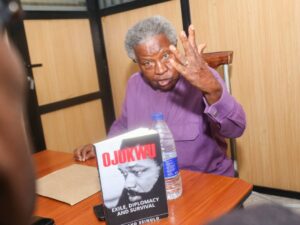
I remember you told me one time that anytime Wole Soyinka and Ojukwu were talking and they wanted to exclude others, two of them will be speaking Yoruba.
Same with Dr. Tai Solarin. I took Tai to Binjaville. And we were discussing Emeka’s possible return to Nigeria, they switched to Yoruba and I said no, no, no. That was also captured in this Book. I had to go downstairs to make myself a cup of Coffee. He was at home with your people. I can tell you that. No person can dispute that. And I’ve said it elsewhere. The only person who can write this book is me. And to some extent, Njideka Ojukwu, the first wife. We witnessed it all.
Why do you say that?
Because she knew what happened in the early days of his exile. Everything was gradually unfolding before our very eyes. This book is exclusive in many important ways.
On the stories of his homecoming. People like you were sent to Nigeria to prepare the ground for all of that.
I came into Nigeria on December 29, 1979.
Who and who are the people you had to talk with? You went to see Chief Obafemi Awolowo.. You went to his house. You couldn’t see him. You had a personal message for him from Ojukwu. And, then met with Ibrahim Tahir, a novelist, the author of The Last Imam. So, tell us about that process. And how did NPN now hijack the process from you people and then turn Ojukwu into an NPN man?
As I told you privately, at this particular point, your brother Kanayo had left. After our meeting at his home in Bingerville after the Pardon had been announced by the Federal Government in Lagos, I politely told General Emeka Ojukwu that I would like to take a rest as he ends his exile and reenters Nigeria. He was heading to his house because the meeting was held in his compound and ended by about 2.35am but away from the main building. Emeka always lived on a large expanse of land. I told him that as soon as the aircraft bringing him home touched ground at the Ikeja International Airport, I will begin my Annual Leave. That was a polite way of exiting. I will be done. That was why I was not at the airport to welcome him. I made it clear to him. I want to concentrate on my Level 09 job with the Nigerian Televion Authority, that was giving me 555 Naira as Salary and Allowances every Month, and it helped me take care of my children’s school fees, cater for my rent, which was 120 Naira month.
Before you go into that aspect of the story, how did you come back to Nigeria to get a job? Can we have that story?
Yes. When I came back, I was cleared with the Nigerian High Commission in Accra. I was cleared. So, my entry was, I won’t say official or dramatic. It was simply smooth. I came and stayed at 245 Ojo Road, Ajegunle. That was where my uncle was still staying. And from there, I moved to Ikeja. Remember that as I was preparing to reenter Nigeria, Emeka got information that there was no way his friends were going to find me a job in Nigeria look for a job for me without my serving in the National Youth Scheme. They insisted I must serve.
So, I went to NYSC National Headquarter in Surulere. I met a lady who gave me a form to fill, and I filled it. She said, I’m sorry there are no vacancies anymore in Lagos. Because I had seen her filling out Maiduguri. I told her pointedly, I will not go to any part of the north. Instead, I’ll go back to the country where I came from. I will not. I lost uncles in the North in1966. She said but Lagos is filled to the brim. There are no vacancies. If there are no vacancies, then exempt me, I suggested. It was then that the Madam Officer, heavily pregnant, said, my, son. I said, Madam. I will post you to Abeokuta. I am from Ogun State. It’s 35 minutes to Lagos. That was what the woman said. She posted me to Ogun State. That’s how I served in Ogun Radio and became a personal friend to Governor Bisi Onabanjo. Ogun Radio was fond of sending me to interview him. So, immediately I settled down and, having spent many years in exile, it became obvious to me that if I must do youth service in Ogun State, I must cultivate friendship there.
But you got a letter from Emeka to Wole Soyinka just to get you a job? And then, of course, to.Bolaji Akinyemi.
Yes, Bolaji Akinyemi, the Prof, and the DG of NIIA on Victoria Island, Lagos who told me that I just skipped the interview that they conducted a few days earlier. And that that was the first time Wole was asking him to help find a job for someone. And he said that he was handicapped. It was at that point that Olu Onagoruwa took over and we focused on NTA. And I got the NTA job.
That was after your youth service.
That was after my youth service. Yes. But while I was doing service, the search for my job had begun. Yes, Emeka’s friends in the SW were seriously helping out. So why should I sit down in a meeting where they are discussing something negative about the Southwest without chipping in conciliatory words? No. We in this Conference Room ought to kick start a body that will promote that Handshake across the Niger for our two peoples. It is becoming a historical responsibility imposed by time and space on our generation.
So, you filled the form for NTA at Onagoruwa’s office and got the job.
Yes. His legal Chambers at Ebute Metta handled it. They submitted the form and I was invited for interview. What I received was an invitation for an interview. Your people have always played critical roles in my life, in my personal life. Oh, yes. Even to survive three years in detention, Ndi-Yorubas played critical role.
Even in detention, they will usually ask: “Kanayo, do you have messages?” I will say Yes. Write it down. I will be on night duty tomorrow. I would take it out, put a stamp, and post it for you. That’s ndiYoruba. Why should I participate in this useless, unproductive and unhelpful confrontation between them and my people on social media? The two people have to reorganize their thinking and save this country. It makes me angry that Ndi-Yoruba and Ndigbo are exchanging hot words publicly about this or that. If this man is not governing well, ruling well, he’s not ruling well. But let’s not base it on his ethnic station. It’s to me kindergarten. If he’s ruling well, we support him in areas where he’s doing good, we should give words of encouragement.
I was going to say that you worked in NTA. For how many years?
Three, four years. Then from there, I migrated to The Guardian as one of its pioneer staff. From Guardian, I left for a company I founded with my friends.
What caused that?
They said there was a strike. The accusation was that as a management staff who attended important Management meetings I should not have been aligning with the NUJ to cause trouble for a new newspaper? But I can tell you this thing happened about 40-something years ago…. I did not attend any meeting. I was clearly sympathetic to the NUJ position, but I did not participate in the planning nor in the execution of the strike action.
What was your role in the Guardian?
I was helping out helping Femi Kusa package news. I didn’t participate in any rebellious meeting against that Ibru organization. I never did. But they roped me in. Why? Kanayo has a rebellious character. He must know something about it. Brainless and unsubstantiated assumption.
More than 40 years after this event, I keep telling our former colleagues, Chuks Iloegbunam, Chima Nwafor, all of them that I never attended those meetings. Because I knew, I was up there. And the people doing this thing are NUJ members. I was a member of NUJ. Yes. But, I didn’t participate in the meetings that led to the protest, for which they said, you people have to go away. And, coming back to Kunle’s question, of those who really facilitated Emeka’s homecoming. Chuba Okadigbo comes number one. Because, at that particular point, Emeka, from exile, from that distance, said, Kanayo, you people have been moving up and down. Look at the person to target, the Political Adviser to the President, Shehu Shagari. Emeka said Chuba OKadigbo visited him in 1968 in Umuahia, in the midst of the war, with other US-based Biafran students like George Obiozor. Target him. All this running up and down with Vincent will yield better results if you get your target right. Chuba is the person to pursue So, that was a new brief. We flew into Lagos on Air Cameroon. That time, many African countries had Airlines. Air Gabon, Air-Cameroon, Ghana Airways, Nigeria Airways, all of them. The Cote d’Ivoire had its own: Air Afrique.
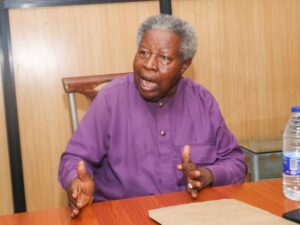
As all those things were going on, did you have to keep at the back of your mind, that one day you will write the book on the exile, that you were keeping all these records?
As the pressure from different sectors continued to mount. Different people said, Kanayo, we read this in TheNEWS magazine, we read this in the Sun, put it together for us. That was why at the public Presentation of the Book in Enugu on January 30, 2025, there were no vacant seats at the Enugu Sports Club venue of the event. My people came. They came. One Otumba flew in from London to be part of the event. Back to your question, when he gave us that instruction, Chuba Okadigbo is the man to target, the whole strategy changed after that day. I flew in, and we, Vincent and I met Gbolabo Ogunsanwo. And we went to Mayflower at Ikenne to tell Tai. Tai asked: What is the problem? I said, our problem is to meet the Leader hero of the Yoruba people, Chief Obafemi Awolowo I was pretty young then. I’m old now. I had dynamism. The brain was hot then. Age has slowed me down. So I told Tai what the brief was. He said, okay. But we’ll keep away from Chief Obafemi Awolowo the NPN angle. Because Chuba Okadigbo represented the NPN. The strategy to meet Chuba is in the book. I didn’t walk into Chuba. After the brief from Binjeville, don’t forget that Emeka had left Yamoussoukro for Binjeville. Yamoussoukro is three and a half hours by road. Binjeville is 15 minutes to Abidjan. We met him. I told my boss in NTA that I wanted to interview Dr. Chuba Okadigbo. Why, he asked? I said, Well, I will use it for the political desk. He said Let me see the questions you would want to ask him. I put the questions down. The following day, he called Alhaji Salam Salaudeen, The Head of Camera. ”You will accompany Kanayo to the State House tomorrow. He will interview the Political Adviser to the President.
The following day, we went to State House. Before Chuba Okadigbo’s secretary, could take us stairs, I told Alhaji Salam: Make una wait for me here. Make me and our Interviewee talk small before I will bring you people up”. Actually, it was targeting Chuba that motivated the interview in the first place. The interview was secondary. So I went up there. I said, I am the man from NTA to interview you, Sir. He said, okay. What’s the name again? I said, Kanayo. But before the interview, Doctor, I have a personal message from General Chukwuemeka Odumegwu-Ojukwu for you, Sir. I am from him. He said, which Emeka? I General Emeka Ojukwu. The man sat back. In the book, I said, either Chuba though that I was a mole or a plant to come and extract certain things from him. But like Editor Chuks Iloegbunam, put it, “God intervened. He works in mysterious ways”
Who came in? Dr. George Obiozor, who knew me in secondary school at Awo-Omamma in the early 60s. a rascal. So, when he entered Chuba’s…
Which secondary school was that?
Community Grammer School, Awo-Omamma.
He shouted my nickname: Kisco.. He said, Kisco, what are you doing here? I said, Doc, I came to share a message with Chuba. But he’s not listening to me. He’s not giving me attention. Then Dr. Obiozor told Chuba in Igbo, “if there’s any person in this country now that can speak for General Ojukwu in Nigeria now, it is the young man sitting before you. That was when Chuba started giving me some attention. Meanwhile, my cameraman and the electrical crew were still downstairs They didn’t know what was transpiring upstairs. But I was upstairs trying to get Dr. Chuba Okadigbo to give my message some attention. So, immediately, George said that, he left. He went back to his office. They all worked in the Presidency. Chuba then asked me if Emeka sent any specific message. I said Yes. And if he wouldn’t mind, he can talk to him directly. “Talk to General Ojukwu”. I wrote out his telephone number and gave it to Chuba. Chuba then called his Secretary. She came upstairs and he told her: Put me through to this number. She did. And the telephone rang upstairs. Chuba said: “Go and pick it up from that Extension. I did. It was the General’s Secretary. I then said, “Can I speak to my General? The Secretary immediately recognized who was speaking. She linked me with Emeka. ”Kanayo.” I said Onyisi. Onyisi in Igbo means the Leader. “Where are you calling from?” I said, from Chuka Okadigbo’s office. He wants to talk to you. So, Chuba picked it up from his end. And they spoke. That was how the thaw was broken. And spoke and subsequently continued to speak in the coming days and weeks. But the few things they could not discuss on telephone, I came into Cote d’Ivoire to fill in. He would ask “Kanayo, when are you having your next free days? And I will tell him and we will agree on my next day of arrival.
You will be travelling during your off days?
My off days. That was how I knew that security knew my movements. And the quantity of newspapers and magazines I carry with me on these trips – Daily Times, Daily Sketch, The Tide, Punch, The Star, The Statesman and New Nigerian marked me out. There was one published from Jos.. . . The Standard. Because Emeka wanted to read them all. And Emma Ackah would wait at the luggage area to retrieve. There were those who would visit Emeka, but wouldn’t want Abidjan Airport immigration stamp because they were afraid of one man called MD Yusufu. So what we do called Dumping and Extraction. You bring Kunle Ajibade into Abidjan, from the airport, we would extract him from the foot of the Aircraft.
With the help of the government, right?
Yeah, of course! You can’t do it without approval. I did my very best for him and for my people. That’s why when Emeka came back to Nigeria, I said, I have played my role. Let me now play the role of a father. By this time, God had blessed me with two children and one of them he named “Emeka”.
Now, there is this part that I would like you to clarify. The part that I would like you to clarify is the part that Tai Solarin took you to Chief Obafemi Awolowo in Ikenne. And you waited in the situation room with your colleague for a long time. Awolowo would not see you. That was before you now went to talk to Okadigbo You were surprised. You will tell us that story. But, before that, how did Emeka himself think of Awolowo? What’s his own perception of Awolowo?
I don’t want to be diplomatic. Emeka recognized that Awo was a great leader. Don’t forget that it was Emeka that said that Awo was the best President Nigeria never had.
He plagiarized Dan Agbese.. It was Dan Agbese who said that but of course …
Emeka could not have plagarized Dan without giving him the credit. They may have read the same ancient Author. Back to my track: When it became obvious that we were moving in the right direction, when it became obvious that Chuba may be approached to lend a helping hand, we decided to expand our coast, we quickly agreed to reach out to Awo. Gbolabo Ogunsanwo had been involved, and we were talking to Tai Solarin. Tai Solarin had promised to take Vincent and I to Awo. And he took us there. The room where he kept us had other seven, eight people waiting to see Awo. But Tai was asked to go in first by the Secretary. He spent about thirty-five minutes. I was doing signs to Vincent Obiano. Vin will be 89 years next month. So, when Tai spending a long time, I began to get worried. The details of Emeka’s message was with me and Tai was going into some forty minutes and counting, I became agitated. Eventually, Tai emerged from the room made us a sign that we should go. When we entered the car.. we came in his car. We parked our car at Mayflower. It was in his car that I recovered from the shock. I said, “Doc, Wetin happen? We no see the leader again. Am I carrying the message back to sender? Vin didn’t even know the substance of that message. So what do I tell our principal? It was in the car that Tai told us that after narrating who we were – that we were sitting in the Situation Room, waiting. And that we were carrying a personal message from Chukwuemeka Odumegwu Ojukwu to him. He said Chief Awolowo told him – and all this are dutifully captured in my Book -“I have no attitude.” We were shocked. This reply or this response was conveyed to Emeka that evening via Ikoyi, Bourdillon, that’s where we were meeting. So, when we conveyed the message, Emeka told us: “Don’t let that discourage you. Concentrate on other matters.” That’s how we began to give all concentration to Chuba, to George Obiozor, to Ibrahim Tahir and to some extent Victor Masi.
Have you for some moment thought about why Awo reacted like that?
I wouldn’t know.
So what do you say of this new resurgence of Biafra in the South-East. Thank goodness, Soludo just sort of put an end to every Monday sit-at-home stuff. Let me know what you think of that.
These are young people. They don’t know what we passed through. Somebody asked me that question in Enugu after the Book Presentation. They were asking me, are you also launching in Lagos? I said I would have loved to but this book was started at the Chancery here in Enugu, in the premises of Dr Arthur Nwankwo.
You were talking about pressure for this Book.
It came from the head of the Chancery. He gave me a room at the Chancery and told me to begin the outline. He said: Let me see the Outline of this book. I gave him more than just the Outline. I gave him the Introduction. I laid out all the chapters. He kept me at the Chancery for eight days and released me only when he was convinced that indeed, I had started. There were also other pressures but Arthur’s was pronounced. He gave me all the encouragement and the push to start this Book. So, I can say that Dr. Arthur Nwankwo laid the foundation for this work. He died when the writing was gaining momentum. Three months into the writing, and I was back to Lagos, I was alerted by Emma, his PA, that his health was deteriorating fast. By the time I got into Enugu by the next available flight, Arthur had left us. I was pained.
But you were talking about the IPOB people, right?
I said they are young people.
For the lack of history and memory of what you went through, they think that war is a tea party.
May be.
War is not a tea party.
It is not. It is not. I remember Dr. Chido, a seasoned Nigerian Editor and Writer, based in USA asking me on a Live Television Interview in Houston Texas what I thought about it? I said, no, I don’t have an attitude. The only thing is that they know something happened to their people between 1966 and 1970, but they don’t know how to comprehend the level of brutality inflicted on our people in the North.
I know, that’s a very diplomatic one.
If you think so.
One of the people you met was Frederick Forsythe. Did you meet other people like him? Talk to us a little about him?
Yes, Fred, as captured in my Book, was his very personal friend., British, Dutch, Swiss, American and other journalists were always coming to interview him. It was organized and coordinated by indomitable Fred Forsythe. Of course, you know, I brought in the Ghanaian editors. They all will be flown in by Fred – all high level editorial staff. General Ojukwu was Editors’s delight any time, any day. Editor Hank, an American, then based in Nairobi, Kenya, was always coming, with or without Fred.
Many journalists were coming. They wanted to know exactly what happened in early January 1970 to our resistance, and why the sudden collapse when things were beginning to look up for our struggle. I will not say more. I was not military.
Okay. So thank you so much for this conversation.
*Credit: TheNEWS Magazine