



By Olabode Opesitan
There is a question every serious nation eventually confronts: Whose voice carries the weight of truth? The voices of those who presided over Nigeria’s long descent into dysfunction, or the sober assessments of global financial institutions that have no stake in our domestic quarrels?
The voices of those who helped hollow out the house have returned. They are now insisting they alone can diagnose its cracks and fix its decadence. That is the paradox Nigeria is living through. The architects of the rot speak with the confidence of surgeons, while the institutions that study economies with cold precision are dismissed as if they were partisan griots.
Yet the record is too glaring to be manipulated.
Over the last three years, the world’s most credible financial institutions have examined Nigeria’s reforms with the detachment of neutral arbiters. The World Bank called the reform trajectory “commendable” and a “global reference point.” The IMF praised the “decisive measures” taken to stabilize the financial system. The African Development Bank highlighted the “foresight, boldness, and determination” behind the removal of subsidies and the unification of exchange rates. The WTO acknowledged that the reforms “stabilized the economy” and halted a downward spiral.
These are not sentimental endorsements. They are assessments grounded in data, institutional memory, and decades of comparative reform experience.
But at home, the loudest critics are often the most implicated. Figures like Dino Melaye, whose political career is remembered more for spectacle than substance, now speak of incompetence and incapacity. They mock borrowing, deride reforms, and insist that Nigeria is “too big” for the man steering it. Yet their critiques collapse under the weight of their own contradictions. They belong to a political class that grew fat while the nation starved, a class that mistook flamboyance for leadership and performance for governance.
The deeper tragedy is not their criticism but the amnesia it relies on.
In May 2023, Nigeria was not merely struggling. It was gasping for breath. Net foreign reserves hovered around 4 billion dollars. Oil production had fallen to 1 million barrels per day. Over 95 percent of government revenue was consumed by debt servicing. Infrastructure was in decay. Universities were on intermittent strike. The health system had collapsed. Even future oil revenues had been mortgaged. Over 50 trillion naira had been printed as Ways and Means. The NNPC, once the fiscal backbone of the nation, was effectively hollowed out by subsidy obligations and arrears.
This was not an economy in distress. It was an economy in free fall.
Reform in such a context is not a matter of ideology. It is a matter of survival. And global history, from Singapore to Germany to Japan, shows that recovery from systemic collapse takes a decade, not three years. The journey from ruin to stability always begins with painful corrections: removal of false comforts, exposure of hidden liabilities, and choices that hurt today to prevent total collapse tomorrow. That is the path Nigeria has been forced to walk.
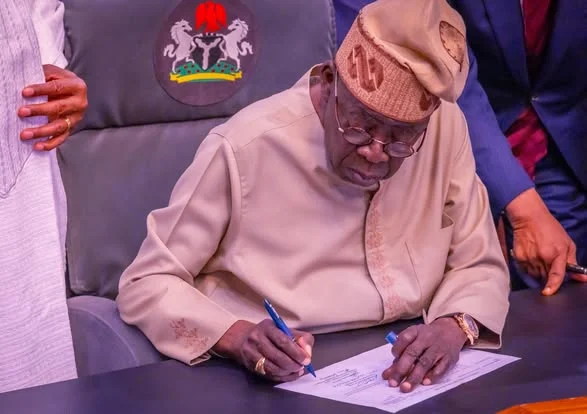
President Bola Tinubu has never pretended otherwise. He has repeatedly acknowledged the pain Nigerians are going through, admitted that the burden is heavy, and appealed for patience. He has thanked the people, again and again, for bearing the hardship while pledging to work harder so that the sacrifices translate into shared prosperity. In his own words and actions, he has treated the pain not as a price to be ignored but as an inevitable step toward recovery and growth, a tunnel that must be passed through, not a condition to be normalized.
Yet in that short time, the indicators have shifted. Oil production has risen up to 1.75 million barrels per day. Road construction is ongoing across regions. Over 1.16 million students have accessed the new loan scheme, receiving more than 206 billion naira. Wheat production is projected to rise from 110,000 metric tonnes in 2022 to 837,891 metric tonnes in 2025, supported by inputs provided to over 628,000 farmers growing various crops. Nigeria’s external reserves have grown to over 50 billion dollars, with net reserves rising above 34.8 billion dollars. Debt obligations have been met without default. The economy, once on life support, is breathing again.
These are not cosmetic achievements. They are structural.
So the question returns, sharper now: Who do you trust?
A group of politicians symbolised by Atiku Abubakar, a former Vice President who supervised the collapse and now performs outrage as theatre, issuing weekly press statements as if noise were a substitute for a plan? Compare that to Kamala Harris in the United States, who has only weighed in on President Donald Trump’s administration a handful of times since losing to him in 2024, choosing statesmanship over brinkmanship. Or the institutions that have no incentive to flatter Nigeria, yet acknowledge that the country is finally confronting the rot it inherited?
History rarely announces its turning points. They arrive quietly, disguised as hard decisions, unpopular reforms, and leaders willing to absorb the blows of a nation’s impatience. Nigeria is not yet where it must be. But it is no longer where it was. That difference did not happen by accident.
It happened because someone chose to face the rot rather than pretend it wasn’t there, to tell the people the truth about necessary pain, and to thank them for enduring it while building the foundations of a more durable prosperity.
And that, in the end, is the only question that matters:
Do you trust the people who broke the house, or the one trying to rebuild it while the debris is still falling.