


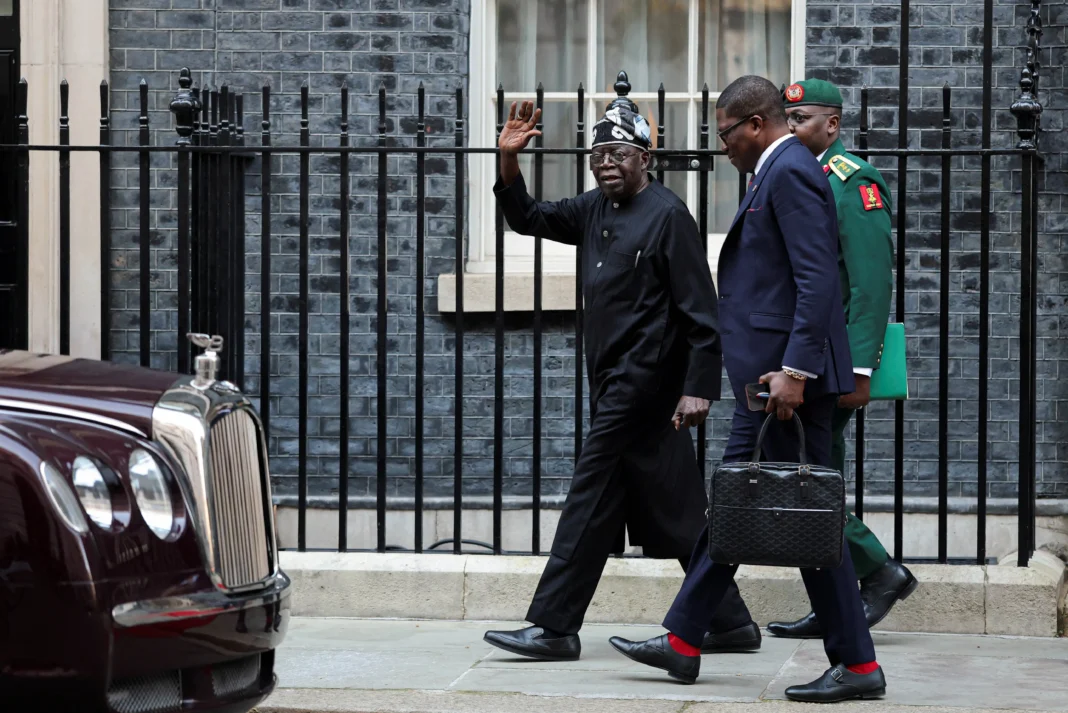

As Tinubu pulls out all the stops to win reelection, the political terrain across Nigeria’s northern region looks increasingly treacherous.
……
This is the inaugural installment in a series of analyses and reflections I will be doing ahead of the Nigerian general election in January of next year. Thematically, I will be focusing on the four basic levers of political power in the country: faith, oil, region, and ethnicity. But since politics in Nigeria is also about so much else outside these main levers, I shall be taking occasional detours into the undergrowth, showing the irrepressibility and vitality of the Nigerian imagination, especially as it manifests through cultural expressions.
Almost three years into a presidency that began on a distinctly rocky note, Nigerian President Bola Tinubu today appears politically unassailable. In a recent private conversation, a top Nigerian commentator who counts himself as a friend of the administration referred to Tinubu, a tad arrogantly, as “Lord of all he surveys.”
From a certain perspective, the hubris is justified. At his inauguration in May 2023, Tinubu looked all but certain to crumble under a barrage of challenges, among them simmering anger from a contentious election, an irate opposition, a festering security situation, and an economy that had been brought to its knees by his incompetent predecessor.
If things feel a little bit different today, it is not because Tinubu has turned Nigeria into Singapore overnight, but because what The Financial Times once described as his “shock therapy” has found approval in the right international financial circles. In January, The Economist hailed Tinubu’s “bitter medicine” and expressed optimism that the Nigerian economy “may be back from the brink.” The newsmagazine’s sanguine assessment was indexed on the following: the rise in the country’s external reserves to a seven-year high $46 billion, the stabilization of the naira following its historic plummeting in 2023, and improvement in oil production in the wake of the political settlement that has brought relative stability to the Niger Delta for the first time in decades.
To be sure, opinion is far from settled on what Tinubu’s “bitter medicine” has done to the patient, and for every international finance guru who is convinced that Nigeria has turned the corner, there are thousands of average Nigerians who would counter that the economic climate across the country has never been gloomier. The Punch newspaper may well have been speaking for this critical segment when it posited recently in a typically feisty commentary that, “For millions of Nigerians grappling daily with hunger and hardship,” talk of the country being “back from the brink” “rings hollow.” Insisting that “the progress touted in official circles finds no echo on the streets,” the paper went on to contend that, “For ordinary Nigerians, life is a daily siege of rising prices, shrinking incomes, and deepening poverty that is fraying the fabric of families and communities.
Similarly, Tinubu can point to the aforementioned settlement in the Niger Delta as evidence of progress on the broader security front, though critics again would rightly counter that the peace now seen in the troubled region has been in the making since the Musa Yar’Adua administration (2007–2010) extended an olive branch to militants with a presidential amnesty program [PDF], and that the only thing the incumbent can properly take credit for is the way in which he has leveraged his long-established personal connections with some of the violence entrepreneurs in the region (Asari-Dokubo and Government “Tompolo” Ekpemupolo, respectively, come to mind) to extract concessions.
Other than that, it is far from clear that the security situation in the country has improved on Tinubu’s watch. The continued onslaught of various jihadist groups in the northern and central regions of the country is the main reason the country now ranks fourth (behind Pakistan, Burkina Faso, and Niger) on the Global Terrorism Index (GTI) [PDF], and while the Tinubu government’s ongoing collaboration with the U.S. military (more on which in a moment) has split opinion, it only goes to show what security experts and observers have known for some time: that Nigeria is in desperate need of help and risks continued bloodbath if the situation is not brought under control.
Where Tinubu has enjoyed unqualified success is in his efforts to emasculate the opposition. When historians eventually tell the story of the Nigerian Fourth Republic, they will likely see Tinubu as the most consequential politician of its all-important opening decades. In corralling a fractured Yoruba political establishment while brokering and lubricating the ethnoregional alliance that remains the backbone of the ruling All Progressives Congress (APC), Tinubu executed, to borrow the words of Nigerian scholar Wale Adebanwi, a “masterwork of political engineering” that no other contemporary Nigerian politician, not even the famously astute Atiku Abubakar, has come close to matching. Having snatched electoral victory against all odds, Tinubu has proceeded to decimate the main opposition party, the People’s Democratic Party (PDP). At the president’s instigation, several PDP governors have switched to the APC, even as the party (PDP) continues to stagger from one crisis to another.
Nevertheless, the more successful Tinubu has been in eviscerating the opposition and consolidating power in the ruling APC, raising the alarming specter of a one-party state (I shall have more to say about this in the series, including a discussion of whether political parties actually exist in Nigeria), the more, arguably, he has elicited discontent and alienated key players in the northern region of the country.
No matter how one spins it, there is no question that today Tinubu is distinctly less popular across northern Nigeria than he was this time three years ago. His problems with the region, where he exceeded expectations at the polls despite fears that going for a Kanuri running mate would hurt his chances, stem from two issues.
The first is persistent northern lament that key appointments in Tinubu’s administration have been skewed in favor of the president’s Yoruba ethnic group; an allegation that, if valid, would mean not just that Tinubu has been acting in breach of the constitutional requirement for regional balance in appointments, but more importantly that he has jettisoned a northern region whose political bigwigs helped him get over the line when his chances of securing the APC presidential ticket were in jeopardy in late 2022. While Tinubu can take comfort in knowing that accusations of ethnic favoritism are par for the course in Nigerian politics, he can ill afford losing ground in a region where, in total, he secured more votes than his Yoruba political base. Tinubu will, rightly, point to Nigerian National Security Adviser Nuhu Ribadu, one of the most powerful people in the current administration, as proof that he has done right by his northern (Fulani) allies, but it does not bode well for him that northern disgruntlement about marginalization persists notwithstanding.
Second: chronic insecurity in northern Nigeria is a potential banana skin. Given the seriousness of the situation and the Nigerian military’s well-documented struggles against various jihadist groups, Tinubu can be forgiven for accepting the U.S. offer of assistance. That said, the military alliance between Abuja and Washington has not gone down well with many northern leaders, including leading Muslim clerics who have accused the United States of having a “hidden agenda.” Others have demanded that the Nigerian authorities halt all military cooperation with the United States immediately “because of its imperial tendencies.” The longer U.S. military personnel remain on the ground in northern Nigeria, the more likely that these voices will get louder, providing potential fodder for political agitation. It seems improbable that a man who won the presidency in the teeth of nearly insurmountable odds will surrender it with executive power and all that it entails now under his thumb. Yet, if Tinubu’s strategy has a soft underbelly, it is his strained relationship with the northern political establishment.
It seems improbable that a man who won the presidency in the teeth of nearly insurmountable odds will surrender it with executive power and all that it entails now under his thumb. Yet, if Tinubu’s strategy has a soft underbelly, it is his strained relationship with the northern political establishment.
*Professor Ebenezer Obadare is Douglas Dillon Senior Fellow for Africa Studies at the Council on Foreign Relations (CFR).This article was originally published by the Council on Foreign Relations (CFR) as part of the Diamonstein-Spielvogel Project on the Future of Democracy: Tinubu’s Northern Trap