
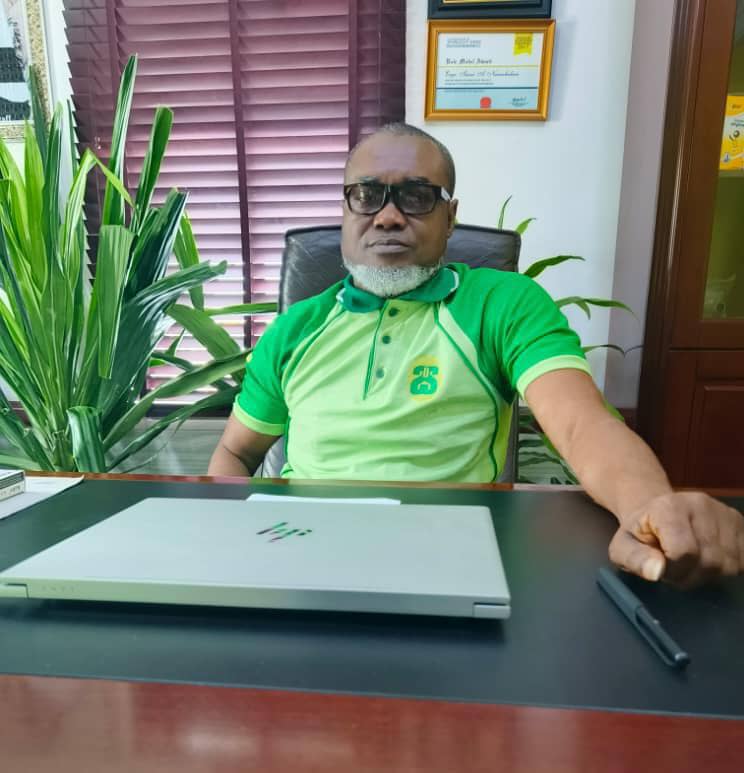

For Anthony Nwachukwu Isiani, the Managing Director/Chief Executive, Schools Development & Support (SDS) International Limited, an engineering solution company revolutionising education across all levels with homegrown innovative technology and science, the nation’s education sector is one avenue the country can harness to boost her foreign exchange earnings. In this interview with Funke Cole, the Enugu-state born entrepreneur who began his entrepreneurship journey over three decades ago on the backstreets of Bariga in Lagos has since grown the business into a thriving conglomerate with branch networks across major cities in Nigeria, the West African sub region, Middle East Asia and still counting. Excerpts:
Your team organised the creative free teachers training with over 1000 school owners and tutors participating. Is this initiative your own corporate social responsibility as a company to give back to the society?
Yes, it is because I cannot fold my hands and allow the community that gave me identity to collapse while I can help. I had to convince my faculty, my workers, that we are going to do it for free. It was a difficult conviction, knowing that this training we do, as of now, cannot be done at less than N2.5m if we are to charge per person. But, we decided to do it all for free. When I explained to them, everybody was so excited to do it. So, we are giving back as CSR, we are giving back as love, we are giving back as a duty from God.
The training programme was both physical and virtual. Do you plan to also take this down to other parts of the country?
We are taking it to other parts of the country in no time. But as I said in another platform, planning to make sure we cover the whole of West Africa, we are working hard on it. We are not just targeting West Africa, East Africa, because we are not just Nigeria. We are targeting West Africa because we believe that if West Africa can move up, Africa will indeed rise. The last training was hybrid because other people couldn’t be physically present. We expected a lot of people from outside the states but due to logistics reasons they couldn’t come. So, we are looking at partnerships with other stakeholders of education such as state governments, business sector, NGOs like UNICEF to partner with us in sponsoring logistics. They don’t need to give us any money. All we need is to pay for their transportation via road, via train or via air and possibly provide the accommodation. We will deliver the training free of charge. Our goal in all of this is to ensure that we provide the knowledge to support the next generations that will come and take over so they can become productive, creative and idea generators.
You have hinted of plans to partner with other stakeholders to deliver free training teachers. Can you tell us in concrete terms what you think the government can also do to assist this cause?
You have struck the rod at the heart of it. If the government can do what it does best, the government starts to benefit more because we have a programme that will convert education to a money-spinning sector. Education can make money just like oil, every other industry. There is a way we can do it that Nigeria as a country can begin to export education. What do I mean by exporting? People coming from outside Nigeria to go to school in Nigeria, and Nigeria will be good. That’s high currency coming into Nigeria. Because of the structure, the results and the way education is being done. Nigeria cannot finish eating money they can get from education. It’s too big. And that is the highest employer of labour in terms of the white-collar jobs. That is the highest employer. If Nigeria can do it right, the money will come from the industry. Government thinks that they will give money. It’s an industry. I’m not even talking about the government giving money. The one that gives itself will become too much if they know what to do. If they know what things to do, money will flow in. Other countries like the UK, Canada, and several others, people go there to study. It’s the money we are paying them to take care of our children. And they are not doing anything better than what we are proposing. By the time we do the things we have in store, no other country can compete with us because they can’t come close! I can tell you that there is nothing as good as having indigenous solutions to your problems. What they are doing is for their own place. So they can’t solve our problem. We should know our problem and by grace of God, a government like this has the ability to dig our ground and convert our ground. Everything we need is here. They will come over here if we set up education right. I remember in my primary school, when my parents were selling, I saw Indians coming to teach in Nigeria because our money there was more than their own. Indians were teaching us. Other foreign nationals were all falling over themselves to come over to teach in Nigeria because of the attractive salary we were offering. That was in the 70s. So imagine if we can bring back those lost glory now? Do you know what we stand to gain? It’s going to be massive. Our education can be done better than anything in the world and we will make real hard currency.
From what you are proposing, do you think this can end the problem of the brain-drain that the country has been suffering from *these past decades?
It will end in a natural death in less than five years. The brain-drain will just die because at the end of the day, nobody would want to live in Nigeria. I’m telling you in all honesty that once you go to school and you have the education to solve the immediate environmental problem, where are you going? And we are starting it from the cradle. We are modeling the students to have the know-how to create solutions right from the classrooms. By extension, you will eventually know how to create domestic solutions when you go home. And when you grow up, you can create solutions to solve problems. After graduation, nobody will give you a job because nobody can pay you. You go to university, you come out, and you say something. From our educational structure, before you enter university, you have known what you want to do. You have known the business you want to do. That’s entrepreneurship. So entrepreneurship we are talking about, entrepreneurship that is based on creativity. Because we say that entrepreneurship without creativity is economic slavery. So what I did as entrepreneurship in Nigeria, just as an economic slavery, somebody will produce something, you package it, you start selling it. What kind of thing? It’s trading. Trading is a completely different thing from entrepreneurship as an enterprise. To be a businessman is a completely different thing. But that is what they made us to believe but they are just repackaging content as a solution. Though, just like you have a factory, where they give you all the machines you need to produce in the factory. Before you make the profit, the machine is done. And the latest machine is out. It’s going to become obsolete. At the same time, it’s getting weak. So you have to buy another one. So if you check the profit the country is making, when the machine and the spare parts, my brother, we are just fueling other people’s economy while our own is in limbo. We are just selling because we can’t produce.
Talking about productivity, SDS has designed, set up, both hardware and software products and services, ultimately. Can you tell us the local content component of the products that you have? Are your inventions completely homegrown or are they a mix of local and foreign?
When we come to our inventions for school, it’s 100% homegrown. But when we come to our production, what we give, what we give in terms of, when we give structures and furnishings for school to support what we do, it’s 100% homegrown. So we basically import some materials that will produce 100% homegrown. Now when we come to some machines, you see machines we fabricated ourselves. We make machines to use in production. So it’s not all machines that we import. So in other words, there is local content in your production. You do a lot of local content. And the joy of it is that the local content you design, the machine designs local content, produces what you want it to design, how you want it to be produced. But when you buy some machines, they can just produce parts how you want. You want to produce pure water. They have machines for production of pure water. So pure water is not ingenious, they have set the mold. You want to produce toilet rolls. They have machines for production of toilet rolls. But when you now want to have a different toilet roll, not tissue paper, you want to have a different tissue paper to meet up with the temperate climate, the tropical region, as we want to do it, you find that it’s not going to be the same and the machine you have cannot produce it. So when you look at the local solution, for a local problem, you want to get it out there. That is where the SDS is different. Most of our products may be higher in price, but at a longer run, it’s much, much cheaper because we know what our customers want. We know they want to get something that will last. So buying China products or some of these foreign products, before you know it, they will just get bad. Obsolescence is a different thing. We’re talking about them just depreciating very quickly. So schools have started finding out that the boards and other teaching aids we produce are more durable as compared to imported products. So we have a standard preparation for it. We are not competing with anyone in the country. So local content is very high.
It has also been argued that tutors and teachers hardly contribute to efficient teaching and learning these days due to absence of training and retraining. What is your take on that?
It is high time we focus on the type of teachers that teach Mathematics and English language. In most of the schools the teachers are not qualified to teach in the kindergarten or nursery section but you see them teaching in the secondary section. What we need is qualified teachers and the right teaching materials.
Improvement of teaching materials and method of implementation is a perfect or most suitable way of teaching in the right direction. The school needs the right facilities in their classroom to teach with so that they can excel. Impacting knowledge to the student in an ideal way using the right teaching facilities and methods require a combined effort of human and teaching aids in an engineering viewpoint.
The education system needs to be responsive and adapt to the changing demands. Subsequently, as the education sector expands, there emerge needs for technology development which only education engineering can offer.
To what extent has your company been able to achieve its vision?
At the risk of sounding immodest, I can say we have been able to achieve our vision to a large extent, as far as providing value-added services to our clientele. One way we have been able to do that is through the application of science and technology to improve efficiency in the classroom using what I call our classroom model. Talking about the classroom model, it is what the teacher needs in a particular class looking at the curriculum; it is not a one-size fit all capsule in a sense. This is because the curriculum of a particular class, for example, the nursery class, is different from what the primary class needs and what the secondary class needs and vice versa.
The first time a child comes to a school what he needs to know is how to identify letters and numbers. Anything you do from the nursery class to the university, all we are looking at is either letters or numbers. But you have to identify it before writing it. In today’s exam, especially in this part of the world, you have to put everything down in black and white. Maybe in the future, exams can go electronic, but today writing still takes pre-eminence over other means of assessment. Let’s take a hypothetical situation, as a scholar, if your handwriting is not decent, your examiner cannot understand you, and in that process you lose a valuable friend as far as that exam is concerned. But when you have a decent handwriting, you get a friend as an examiner. Immediately he opens your paper he tries to get the point you are trying to make and scores you appropriately. However, if your handwriting is not decent and the examiner cannot understand you, then it becomes a problem for him to assess you accordingly.
As a company, what we have done is to fill this yawning gap by making handwriting a culture that can be sustained rather than as a mere subject being taught in the lower classes. We have designed different kinds of boards to aid the student so that as he or she progresses, the culture of good handwriting can be sustained to a large extent.
I give you another example: If you look at the number of students taking mathematics during most examinations these days, you discover that only a few of them take the graph option, many of these students are all shying away. But the graph option ironically, is more practical than anything. But students are all running away because there is a failure in the facility provision. In most of these classrooms, there is no efficiency in transferring this knowledge to the students because the teachers don’t have graph boards to better illustrate whatever points he wants to make. But in a case where the teacher has a graph board, the transmission of this knowledge becomes rather seamless.
Can you share your vision for the company in another five years?
The future of the company is so bright. Our products are highly indigenous. It belongs to Nigerians, by a Nigerian. But now, we’re looking at expanding outside the frontiers of Nigeria, specifically across the West African sub region. We have made inroads to Ghana, where they are already excited about our products. But we’re looking at West Africa first and foremost for a very strategic reason. Across the West African sub-region, you find that we’re academically backward. So, we have brought out these solutions to address some of the challenges in our educational system. We’re looking at inefficiency within our environment. What we want to offer is a holistic solution to some of these identified problems: the people, the environment and the opportunities therein. In the next five years, we hope that we will have penetrated the entire nation, where at the risk of sounding immodest, I can tell you without any sense of contradiction that already our products are of international quality, they’re branded, and it has gained general acceptance locally.