


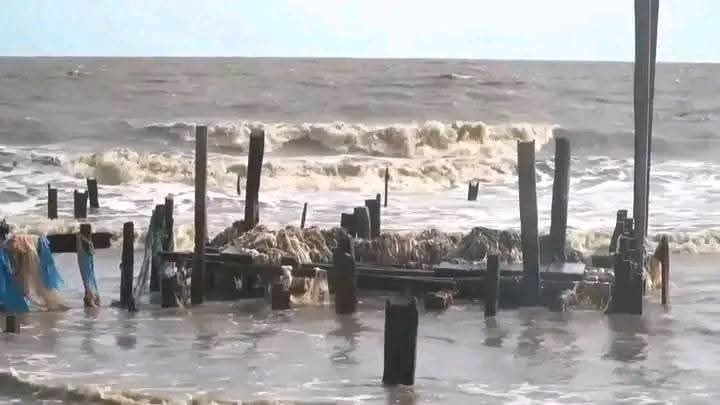

Those years now feel distant but strangely vivid! Then, the coastline of Ilaje stood firm and untroubled, as though it had made a quiet promise to remain unchanged. In those years, the ocean was a companion – its tides predictable, its edges gentle, its presence soothing rather than threatening.
I remember stretches of earth that seemed endless, mangrove roots gripping the earth with quiet confidence, and the air carrying the scent of salt and freedom rather than fear and anxiety.
A coastline quite unlike the loose, shifting sands of Lagos bar beach; it was a firm, compact earth, a unique blend of clay and sand, strong beneath our feet, holding its shape as if it understood it was meant to endure.
Back then – through the 1970s and well into the early 1980s – the shoreline felt like something permanent, almost eternal. It was a place where childhood could stretch itself out under open skies without fear of disappearance.

We walked the shoreline with the ease of people who believed the land would always be there waiting for them. From one community to another, the journey was not marked by distance or difficulty, but by the rhythm of laughter, footprints, and the steady hush of waves that never seemed threatening.
The coast was our playground. It was an open space where boundaries dissolved and childhood expanded freely between fishing settlements. I still remember how inter-house sports were held right on the beach, where banners of different houses fluttered against the coastal breeze. We ran races with the ocean watching closely, cheered by voices carried far by the wind.
The coast was also our stadium – broad, open, and alive with energy whenever rival schools came together. I can still picture the intensity of those football matches: Happy City College, Ayetoro locking horns with C&S Academy, Ugbonla, or Community Grammar School, Orioke-Iwamimo facing off against Community Grammar School, Zion-Pepe. The earth would scatter with every tackle, and every hopeful shot at goal.
In those moments, the coast was not something to fear or defend; it was simply part of our growing up – alive, generous, and unbroken. It held our ambitions, our pride, and our youthful determination – turning ordinary school matches into unforgettable spectacles played out on the edge of the ocean.
At night, the coast became something different entirely – quieter, more mysterious, yet still familiar enough to trust. We would walk its length under starlit skies, the moon casting a pale path over the ocean as we made our way to ẹbọ (night parties) in nearby villages. The sea turned into a silent companion guiding our steps, and its waves a distant rhythm to the owanbe music waiting ahead. We would stay until the early hours, when the celebrations faded into tired conversations, and then begin the journey back home as dawn slowly stretched across the horizon.
In the coast we had a huge event centre, a vast and open gathering place where life’s most significant moments unfolded. It was there, especially during burial ceremonies, that the community came together in solemn unity – tents rising against the backdrop of the sea, voices blending in songs celebrating life. The ocean stood nearby, constant and watchful, as if bearing witness to both our losses and our enduring bonds.
And for the fishermen, the shore was a place of return, when the day’s labour met the quiet relief of homecoming. We would watch as they emerged from the ocean, their boats rising and falling gently before finally yielding to the waiting shore. The coast received them like an old friend – steady, familiar, dependable. Soon, we gathered around them, sorting through the fresh catches, separating fish with practised hands while stories from the sea flowed just as freely.
Nearby, torn nets were spread out under the open sky, carefully mended stitch by stitch, each repair a small act of hope for the next journey. In those moments, the coast was more than land; it was a living workplace, a meeting point of effort, survival, and community.
Then came the years of rage, when the ocean shed its calm and return with a force we had never known. It no longer stopped where it used to, but pushed forward relentlessly, swallowing the familiar stretch of coastline, creeping into our homes, and erasing the spaces where our lives had taken root.
Walls are giving way, pathways are disappearing, and landmarks that once guided us are becoming memories overnight. Families are being forced to retreat, leaving behind ancestral grounds that had held generations before us.
In the aftermath, explanations began to surface, each trying to make sense of the loss that felt too vast to grasp. Some are pointing to years of oil exploration, arguing that the disruption of the seabed and surrounding ecosystems weakened the natural balance that once held the shoreline in place. Others spoke of climate change, of rising sea levels and shifting weather patterns.
But in the face of ravaging ocean, there was no argument to make, no strength to summon against it – we could only watch, displaced and diminished, as the sea claimed what we could not protect.
Jide Ololajulo, PhD, writes from Abuja