


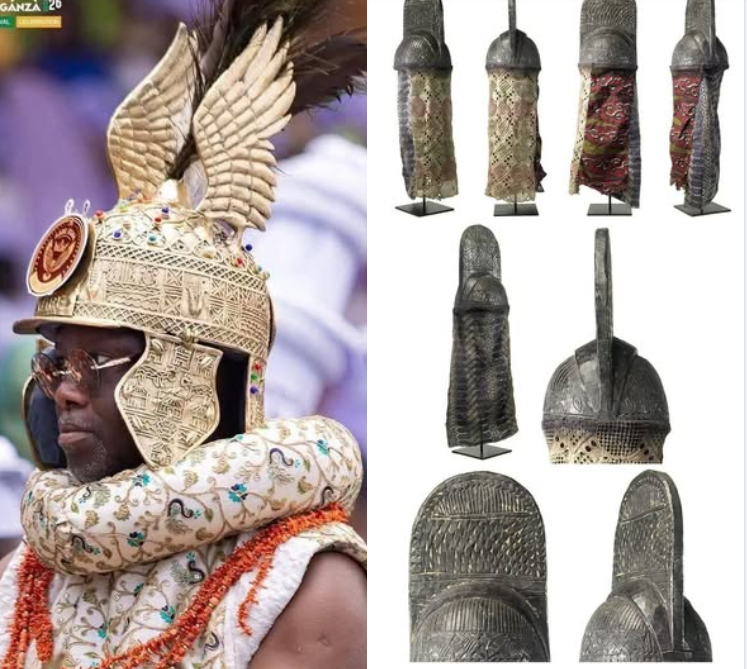

A cultural note on history, symbolism, and public memory
“If some saw Sparta, I saw something older: the Yoruba truth that the head is never ordinary. Our fathers did not go bareheaded into history, and we should not go bareheaded in memory. If a headgear provokes debate, let it also provoke learning — because heritage is not a museum of fear; it is a workshop of courage.”
My people of Egbaland, and friends at home and abroad,
One of my headpieces at Egbaliganza 2026 has generated spirited discussion, both supportive and critical. That, in itself, is not a problem. Serious cultural work often invites serious questions. No tradition remains alive by avoiding engagement. People confident in their heritage must also be confident enough to explain it.
What should remain beyond dispute, however, is that Egbaliganza has helped draw renewed attention to the Lisabi Festival and has contributed meaningfully to its emergence as one of the country’s most visible cultural celebrations. Yet visibility alone is not the point. The true value of such a platform lies in whether it deepens understanding, preserves memory, and presents our heritage with dignity.
It is in that spirit that I address the question of the headgear.
I speak with reverence for our past and with hope for what we are building for the future. In shaping the helmet-like headgear used for Egbaliganza as part of the Lisabi Festival, the intention was never to create novelty for its own sake. It was to teach, to remember, and to renew a story of courage, dignity, and identity so that it may remain alive for generations to come.
At a time when Egbaland is receiving growing attention — including the presence of visitors and well-wishers from more than 30 countries who came to celebrate Lisabi and pay homage to Kabiyesi, the Alake — it is important that we do not become distracted by the scale of the occasion alone. The larger task is to understand the meaning behind what we present. Recognition, whether local, national, or global, must ultimately rest on substance: on history, culture, craftsmanship, and faithful remembrance. In this regard, the reawakening of the Lisabi Festival through Egbaliganza, encouraged by Kabiyesi Alake and advanced through the work of the Lai Labode Heritage Foundation, should be seen not merely as a spectacle but as heritage work.
Why the headgear matters
The question has been asked: why a helmet?
The answer is historical, cultural, and symbolic.
Among the Yoruba, the head — orí— is never ordinary. It is the seat of identity, destiny, authority, and spiritual individuality. For that reason, what covers or adorns the head has always carried significance, whether in kingship, ritual life, hunting, or warfare. Across Yoruba history, rulers, titled men, hunters, and warriors used various forms of headgear to signify protection, rank, readiness, prestige, and office.[2]
It is important to state this clearly: the idea of martial head covering is not foreign to Yoruba tradition. What many today call a “helmet” did not always appear in one uniform shape or in the standardised metal form associated with modern European military history. In Yoruba settings, martial headgear could take the form of war caps, crested coverings, heavily reinforced cloth headpieces, leather constructions, and other protective or status-bearing forms used in battle and martial display. The terminology may differ across sources, but the principle remains the same: the Yoruba did not approach warfare as if the head were without importance.
So the headgear created for Egbaliganza should not be misunderstood as an invention detached from tradition. It is better understood as a contemporary interpretation of an older truth — that the Yoruba warrior, like the Yoruba king, did not treat the head casually.
History supports the symbolism
Yoruba warfare was organised, strategic, and highly visual. Historical accounts of nineteenth-century Yoruba military culture describe regiments, commanders, war banners, weapons, protective dress, and insignia of rank. Dress, in such contexts, was not incidental. It communicated readiness, hierarchy, and power. Scholars of Yoruba art and history have long shown that attire was central to how authority was represented, both in the court and beyond it.[5]
In the wider Yoruba world, headgear has consistently signified identity and dignity. Royal crowns, beaded veils, hunters’ caps, war-associated caps, and lineage-specific head coverings all belong to a cultural continuum in which the head is both protected and honoured. This is why the symbolism of the helmet resonates so strongly: it stands at the intersection of memory and responsibility.
The metal crown and plume used in Egbaliganza, therefore, represent more than decoration. They translate martial memory into ceremonial language. They recall the defenders of Egbaland while also pointing to the discipline, stewardship, and wisdom expected of leadership today.
Why Egbaliganza matters
Egbaliganza is not merely a fashion expression. It is a cultural statement. It is a creative reaffirmation of Egba identity and a way of making heritage visible again, especially to younger generations who must be invited into tradition, not alienated from it.
Every aspect of the regalia carries meaning. The sword, the brocade, the beads, the flowing robe, the commanding collar, and the headgear each speak to a different strand of the Egba story — courage, nobility, sacrifice, continuity, memory, and guardianship. These are not garments assembled merely for applause. They are visual texts.
That is why cultural renewal matters. When symbols are thoughtfully used, they do not diminish tradition; they help tradition speak anew.
On craft, preservation, and public memory
One of the quiet strengths of this movement has been the revival of local craft. Tailors, textile workers, stylists, bead workers, and designers in Abeokuta and beyond have helped translate heritage into forms that people can see, wear, discuss, and remember. That matters. Culture survives not only in archives and palaces, but also in hands, workshops, homes, and festivals.
The renewed use of Aso Oke, Adire, Damask, embroidery, and heritage-inspired ceremonial fashion has helped restore dignity to indigenous aesthetics. In the same way, the reappearance of older visual motifs — including marks of identity, martial references, and historic accessories — keeps important conversations alive. Preservation is not achieved by freezing culture in silence. It is achieved by carrying it forward with care, understanding, and integrity.
On criticism and civic engagement
Questions should not be feared. They are part of a healthy cultural life. No society preserves its heritage well by discouraging inquiry. If people ask why this form of headgear appears in Egba regalia, they deserve an answer rooted in history, not irritation.
The answer is that Yoruba civilisation has long attached importance to the head in both sacred and social life; that Yoruba visual culture includes many forms of significant headgear; that martial head coverings and war-associated caps are historically attested; and that contemporary cultural design can, when responsibly done, interpret these traditions without betraying them.
Debate, when honest, can strengthen public understanding. The proper response is not defensiveness, but evidence. Great leaders are not afraid to engage. And no meaningful title — certainly not one bound up with service and public trust — should be afraid of explanation.
A larger lesson
The deeper message of the regalia is this: a people who remember who they are can shape where they are going.
Lisabi stands in our history not only as a figure of resistance, but as a symbol of organized courage and collective dignity in Egba memory. To remember him well is not merely to celebrate his heroism, but to educate a new generation about the values that sustained Egba identity: courage with discipline, strength with purpose, and pride without arrogance.
That is why the headgear matters. It is not an empty flourish. It is a teaching device. It says that memory must be worn with responsibility. It says that heritage can be majestic without becoming boastful. It says that Egbaland can present itself to the world with confidence while remaining rooted in documented history.
A closing word
Let the Lisabi Festival continue to be a place of learning as much as celebration. Let what we wear not only impress the eye, but instruct the mind. Let the young understand that our traditions were never weak, never shapeless, and never without sophistication.
And let us not be distracted only by the attention Egbaland now receives, however noteworthy that may be. The more lasting achievement is cultural renewal: the careful reawakening of memory, dignity, and identity. In that work, Egbaliganza has helped reopen an important conversation, and the efforts of the Lai Labode Heritage Foundation — inspired by the encouragement and vision of Kabiyesi Alake — deserve to be understood in that light.
May our past continue to guide us with wisdom, and may Egbaland move forward with dignity, knowledge, and grace.