


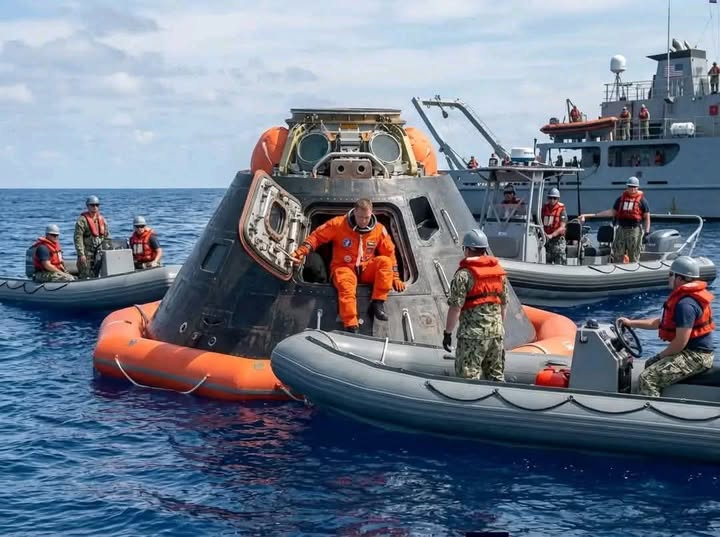

NASA’s Artemis II astronauts have returned safely to Earth, completing the first crewed mission to travel around the Moon in more than 50 years.
The Orion spacecraft, according to Al Jazeera and other agencies’ reports, splashed down in the Pacific Ocean off the coast of California at 5:07 pm local time (00:07 GMT) on Friday, following a high-speed re-entry through Earth’s atmosphere.
Recovery teams were already in position, moving quickly to secure the capsule and bring the crew aboard.
On board were NASA astronauts Reid Wiseman, Victor Glover and Christina Koch, along with Canadian astronaut Jeremy Hansen.
Minutes before re-entry, Wiseman, the mission commander, radioed mission control: “We got a great view of the Moon out window 2 – looks a little smaller than yesterday.”
“Guess we’ll have to go back,” came the reply from Houston.
The return marked a crucial test for the Orion spacecraft, built by Lockheed Martin, demonstrating it can safely withstand the intense conditions of a lunar re-entry.
The capsule endured a dramatic 13-minute descent, slamming into the atmosphere at extreme speed. Temperatures on its exterior climbed to about 2,760 degrees Celsius (5,000 degrees Fahrenheit), hot enough to generate a plasma layer that briefly cut off communications with the crew.
Contact was restored as parachutes deployed, slowing Orion’s descent before it gently hit the ocean.
Recovery crews later opened the hatch and began extracting the astronauts, who reported minor communication issues but were otherwise in good condition.
“We are back in the business of sending astronauts to the moon, bringing them back safely and are set up for a series more,” said NASA chief Jared Isaacman from a US Navy recovery ship.
The four astronauts launched just over a week ago from the Kennedy Space Center in Florida, embarking on a 10-day journey that took them farther from Earth than any humans since the Apollo era.
They travelled around the far side of the Moon, testing systems designed for future missions, before heading back to Earth.
A new perspective on Earth
Artemis II is widely seen as a critical test flight for future Moon missions, particularly Artemis IV, which aims to land astronauts on the lunar surface for the first time since the Apollo era.
Engineers will now analyse key data from the mission, including the performance of the Orion capsule’s heat shield as well as navigation systems and life-support technology, all essential for safely carrying humans deeper into space.
The return also included one of the most challenging phases of the journey: a brief communication blackout during re-entry, caused by intense heat building up around the spacecraft.
But on top of its record-setting distance, the mission also marked other historic firsts. Glover became the first person of colour to travel around the moon, Koch the first woman, and Hansen the first non-American.
During their journey, the crew reported in vivid detail features of the lunar surface and later witnessed a solar eclipse as well as meteorite impacts.
Mission commander Wiseman reflected that “what we really hoped in our soul is that we could, for just a moment, have the world pause – and remember that this is a beautiful planet in a very special place in our universe”.
“We should all cherish what we have been gifted.”
Every morning since the astronauts’ departure, NASA has sent a song to Artemis II to start the day.
On Friday, the astronauts awoke to the tune of Live’s song Run to the Water and the country hit Free, by Zac Brown Band.

How Humans Return from the Moon
By Chadrin Nseemani
Traveling from the Moon back to Earth may sound like something simple, just “coming home” but in reality, it is one of the most dangerous and carefully calculated journeys humans can make.
After completing their mission on or around the Moon, astronauts board a spacecraft such as the Orion spacecraft and begin their journey back. To leave the Moon, they must fire powerful engines to escape its gravity. This is similar to throwing a stone hard enough to get out of a deep valley. Once they break free, they don’t keep firing engines the whole way.
Instead, they enter space and begin coasting, while Earth’s gravity slowly pulls them back home.
As the spacecraft travels through space for several days, Earth’s gravitational pull becomes stronger and stronger. This causes the spacecraft to accelerate to incredible speeds. By the time it reaches Earth, it is moving at around 38,000 kilometres per hour. At this speed, returning safely becomes a serious challenge.
The most dangerous moment is called reentry. when the spacecraft hits Earth’s atmosphere. At such high speed, the air in front of the spacecraft cannot move out of the way fast enough. It gets compressed, and this compression creates extreme heat, forming a fiery layer around the spacecraft. This is not the spacecraft burning in space, but the air itself heating up to thousands of degrees.
To survive this, the spacecraft is protected by a special heat shield. This shield is designed to absorb and withstand the intense heat by slowly burning away on purpose. It sacrifices itself to keep the astronauts inside safe. Without it, the heat would be deadly within seconds.
As the spacecraft continues through the atmosphere, it begins to slow down. The air acts like a natural brake, reducing the speed from tens of thousands of kilometres per hour to much lower speeds. However, slowing down is not enough on its own.
As the capsule gets closer to Earth, parachutes are deployed in stages. First, smaller parachutes help stabilize the spacecraft. Then larger parachutes open to slow it down even more, ensuring that it does not hit the surface too fast.
Finally, the spacecraft lands in the ocean, usually in a carefully selected area of the Pacific. Recovery teams are already waiting nearby to retrieve the astronauts and bring them safely back.
In simple terms, returning from the Moon is a journey of controlled falling, falling toward Earth at extreme speed, surviving intense heat, slowing down step by step, and landing safely in water. Every part of the process must work perfectly, because even the smallest error can turn a safe return into a life-threatening situation.
*Chadrin Nseemani posted this piece on Facebook