



By Bisi Anyadike
As I reflect on my journey, I am reminded of the transformative power of education and the impact one person can have on shaping our perspectives. Professor Biodun Jeyifo, my teacher and a beacon of intellectual curiosity and decolonization, has been that guiding light for many of us.
His unwavering commitment to challenging colonial narratives and promoting African cultural heritage has inspired generations of scholars, activists, thinkers, and teachers alike.
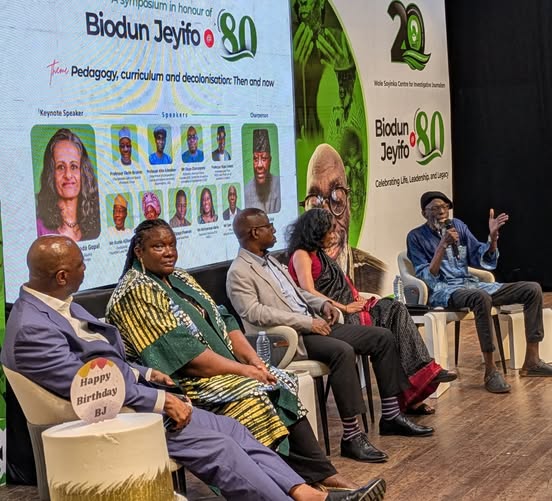
As we celebrate his 80th birthday, I am honoured to share my personal journey of growth and self-discovery, influenced by his teachings and philosophy.
Arriving in Ife at 18 from a very colonial background and an even more pseudo-colonial upbringing, and also as a post four-year ‘Been-to born’ 13- year- old returnee, I was pretty much doomed to a colonized existence as a Nigerian.
After a very brief stint at Adventist Grammar School, Ede, I moved to Federal Government Girls’ College, Calabar, where whatever colonial bits and pieces got dented at AGS Ede were quickly panel-beaten back into place in Calabar; Scottish Principal, Irish Vice Principal; no vernacular, so I no longer had to struggle with the harrowing pronunciations of Ojo-Man, Ojo-day, Ojo-rain or any other Nigerian language for that matter. Literature was much more familiar to me; Greek Men and Gods; Brontë’s Wuthering Heights and all the Odes to Ancient Mariners. Yes, I was at home and comfortable, and my horrible London accent that expressed impeccable ‘Queen’s English’ was acceptable and respected, especially by my peers rather than being rendered the laughingstock of the school, like it was back at Ede!
That was the young girl who came into Ife to study English Education in 1980. The trajectory probably would have followed its destined path had it not been for the Literature Department, (my learning in my faculty, Education remained pretty much colonized, except in dear Helen Watson’s classes) I would have ended up jumping on the next plane back to HRM the Queen’s sovereignty upon graduation, but something got ignited by a great team of lecturers in Literature; there were a good number of them, not the majority in number, but with such a powerful positive impact that outnumber ten times any other number of individuals.
Those who know me well, know that two lecturers of that era stand out very significantly in my life, in similar but different ways. Today, however, we are celebrating Prof. Biodun Jeyifo, Uncle BJ, so this is about him. I will share more about the other when he clocks 80, too, a few years from now.
Prof. Biodun Jeyifo, like all our favourite lecturers, was the kind of lecturer that held you spellbound the very first class as he walked in, scraggy in his brown needle-cord trousers and barely buttoned-up shirt and vintage Ivy cap, but never the less attractive in all his scragginess! But it was when he began his lectures, then we really became spellbound! His classes were always dynamic, captivating and deeply thought-provoking discussions – he never for one day dictated notes – the only things he ever stopped to let us write were either a quote or a reference he would suggest we check. Through lively and often heated debates on topics that flew out of the books we read, current issues of the time, and peaks into the future, I found that I had unwittingly begun to shake off what I came to realize were subtle remnants of my personal colonisation that I once took ignorant pride in.
Through Prof. Biodun Jeyifo’s classes, it became clear to me and then possible for me to begin to acknowledge how colonialism shaped our societies, cultures, and our minds, and to begin to actively work towards undoing its impact. Interestingly I do not recollect him at any point actually instructing me towards taking such steps, but I do remember some of the books I read that led me like I had a noose round my neck, or maybe the other way round- the noose round my neck was loosened.
I can’t recollect now whether I worked my way into his tutorial groups or whether I was actually placed there by fortitude, but it was in those one-hour groups twice a week, together with my classmates Femi Ojudu, Femi and Laolu Macaulay, Sam Omatseye, Nola Karunwi, Bola Anjorin and Biola Agbebi to mention a few, that a complete pro-Nigerian, pro-African Renaissance took place in me.
I found myself, during my second and third years, challenging my own and imposed Western-centric views in history, education, and culture, reclaiming an identity I failed to accept as mine. I also began making a huge attempt at revitalizing my own language (I so regretted my Ojo lapses), valuable Nigerian traditions, and our deep knowledge systems that I learned had so much to offer.
In addition, his union activities outside the class were second to none in whipping up the strength and courage in young undergraduates to question power imbalances, tackle economic, political, and social inequalities subtly perpetuated by colonialism. A major mover for me at the time was reading widely, very widely, on Prof. Jeyifo’s recommendations. He had us reading about everything in print on Africa, by Africans, and about Africa. Two readings among many others touched me – Lewis Nkosi’s Tasks and Masks. Not as heavy as a lot of his recommended reads, but for me, it brought to the fore the struggle we go through to define ourselves amidst colonial influences and our rich traditional heritage. The challenges of navigating multiple identities – the ‘masks’ we all wore to fit into societal expectations. This singular book, which I didn’t put down until I finished it, brought home to me the role of art and literature in expressing our true identity and the importance of challenging colonial narratives.
The other book we discussed, debated, and got very high-strung on during Prof. Jeyifo’s tutorial classes was Fágúnwà’s A Forest of a Thousand Demons. At first, it was difficult to comprehend the significance and importance of what most of us regarded as a simple folktale. Prof. Jeyifo all but lost his patience. He painstakingly drew our attention and led us to the final realization that Fágúnwà skilfully subverted colonial stereotypes, showcasing the richness and complexity of our culture, defying the simplistic colonial portrayals we had grown up with and accepted as us.
If we weren’t in Aud 2 having lectures, in his office in Humanities Block 1 ground floor having heated debates at tutorials or at the Sports Centre warming up for one more heavy protest, we were either in the Pit Theatre or Oduduwa Hall delving into his passion for and expertise with the theatre. Once we even had a special lecture by him to learn by heart Wole Soyinka’s ‘Etika Revolution’ I think it lasted three hours. I believe my love for my country Nigeria soared that day and I swore to live and die here no matter what.
Prof. Jeyifo, as a teacher, did so much towards steering us to becoming truly decolonized beings. It wasn’t an easy task, and it wasn’t the whole class that got carried along, and even those of us who did, it wasn’t as smooth as it sounds in retrospect. I remember in my fourth year, along with some of his other students and colleagues, I was invited to his home for an evening out. It was my first time in his home, and most of us were intrigued by his collection of art, which included many African carvings and masks. I made the gross error of asking why African carvings were always so ugly compared to the beauty of European statues and busts. This time, he did go berserk but calmed down in good time and explained my folly to me in such detail that I have never seen an ugly piece of African art since then!
I often have read things where Prof. Jeyifo is accused of having failed to deliver the revolution he promised, personally I see that Prof. Jeyifo and his ideological comrades were actually advocating for a more subtle, yet profound, revolution – one that targeted the mindsets and perspectives of individuals, rather than seeking to overthrow the existing power structures through violence. As Bob Marley sang to us ” “Emancipate yourself from mental slavery, none but ourselves can free our minds” and as is also echoed in the themes of Fela’s songs “Suffering and Shmiling,” “Zombie,” and “Beast of No Nation,” true revolution often begins with a shift in consciousness. Education and personal transformation are powerful catalysts for change. By influencing the thoughts, attitudes, and values of students like me, Prof. Jeyifo, I believe was quietly shaping a new generation of leaders and thinkers who would go on to challenge and transform the status quo in our own ways. This is more prominent in his students who went on into journalism, writing, lecturing, law and politics but there are a good number of us teachers, quietly carrying on the revolution too. Prof. Jeyifo’s approach has a ripple effect that has extended far beyond his immediate circle. This kind of silent revolution can be incredibly effective, as it allows individuals to develop their own agency and autonomy, rather than being forced to conform to a predetermined ideology.
Today, I am a teacher and have been one for the last forty years. I proudly teach young children in primary school and am even more proud to claim that the influence of being a student of Prof. Jeyifo has enabled me to take a path towards educating young Nigerians that is less taken, but I believe ought to be the norm. It is a tough path to be on, one often gets misunderstood, and therefore unaccepted by many and it shows how much further we have to go for complete decolonization.
Refusing to be deterred however, my curriculum sets a store on children learning their mother tongue, incorporates local histories and perspectives; it is also diversified to include non-Western thinkers and ideas. Children are encouraged to think critically about colonial legacies, by learning about horrible histories of the Western world too. One of the most powerful weapons we use is introducing them to our literature, with Chinua Achebe’s Things Fall Apart and Wole Soyinka’s abridged Aké on the top of the reading list for our 9-10 year olds. They are introduced early to role models from the past and living and Prof. Jeyifo is one prominent figure they have encountered in various ways over the last thirty years. We encourage them to make use of their voice and make it heard. During the last prolonged ASUU strike my pupils took to the streets with placards defending their future.
It’s not being an easy task convincing parents that this is the way to go, but we keep going.
Every year, we celebrate a big Cultural Day festival where we choose a theme from our traditions across Nigeria. One year, we celebrated the Tiv Kwagh-Hi of Benue State; a beautiful tradition of puppetry, dances, drama, song and masquerades, all the way to Ile-Ife in its splendour and beauty, and the children were ecstatic with joy. Parents, however, raged war. How dare I bring ‘pagans’ and masquerades to the school grounds? How dare I subject their children to such! An emergency PTA meeting was called, and I was demanded to tender an apology. I tried to use Sesamy Street, Big Bird, and the Cookie Monster in my defence, I failed and so apologized, but with a clause – no masquerades, no more Father Christmas! In the end, Father Christmas stayed, and so did our Culture Day!
Prof. Jeyifo’s influence has had a lasting impact on my life and perspective, and it is very important to me that I pay it forward as a teacher. The fact that many of my classmates and other students of his, all over the world, have gone on to become influential voices in their respective fields is evidence of his effectiveness as a mentor and educator. The ripple effect is exactly what makes his kind of revolution so powerful – it’s a slow-burning fire that spreads quietly but with profound impact. By empowering individuals to think critically and challenge the status quo, Prof. Jeyifo has helped create a generation of leaders who are equipped to drive meaningful change.
I must not end this tribute, however, without highlighting perhaps the most powerful influence of Prof. Biodun Jeyifo’s decolonization on me as an individual, and this was to enable me to realize that ‘Prince Charming’ isn’t necessarily that tall, dark, handsome six-pack-built guy – depicted in everything Western, I found out he’s that loving and caring, truly African man. Light in complexion, well, I give in to the handsome bit, though… after all, decolonisation is an ongoing process, isn’t it? But this fact and the realization of it has had a huge impact on my life and provides me with the strength to be person I am today and not the person I might have sadly remained. Evidently, I was a very good student, even if I did struggle to make only a B grade in all Prof. jeyifo’s courses back in the day. Although it is a known fact that for all his generosity of heart, spirit, time, and finances, he was extremely stingy with grades.
As Prof. Biodun Jeyifo celebrates his 80th birthday, I wish him more happy years added to his already many fulfilling years; years filled with joy, love, and continued inspiration to all those around him.
May his legacy continue to shape and influence generations to come, and may his passion for decolonization and social justice remain a guiding light for us all. Uncle BJ today we honour you for all the value you have added to the lives of others and to very many yet to be nourished by the seeds you have spent a lifetime nurturing, seeds that begun to blossom in your lifetime and will flourish for all time! Happy 80th birthday, Uncle BJ! May your legacy continue to inspire and ignite minds for generations to come!
-Anyadike is the Proprietor of
Sunshine Nursery and Primary School, Ile -Ife,
Osun State