


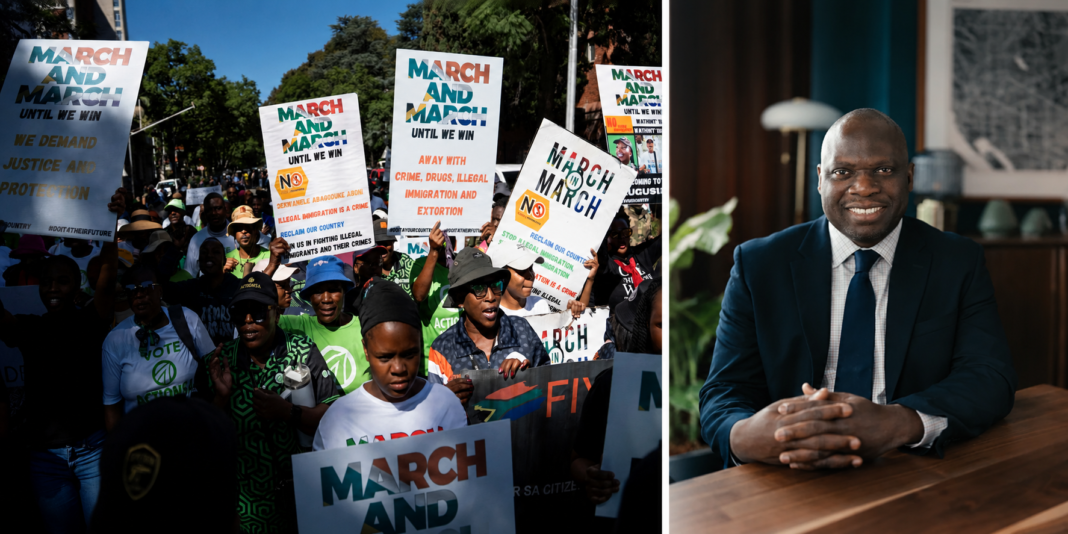

The country’s elite is paying the price for championing dubious ideologies at the expense of basic economics.
,,,,,
You know we are in uncharted waters when Julius Malema is the one playing the role of peacemaker, but that is precisely the situation in which South Africa now finds itself. Ordinarily uncompromising in his rhetoric, Mr. Malema, leader of the black nationalist Economic Freedom Fighters political party, has of late been appealing to his fellow South Africans to stop attacking immigrants from other African countries and reminding them of the need to “uphold human dignity and the rule of law.”
Following his sentencing last month to five years in prison for unlawful possession of a firearm and discharging a weapon in public, Mr. Malema clearly has his own beef with the system, and it is not impossible that his outspokenness on an issue that has put the South African elite in a difficult situation is motivated by a diabolical calculation to save his political skin. Regardless, Mr. Malema deserves full credit for speaking out when the leadership of the ruling African National Congress has cowardly retreated behind a wall of silence for fear of alienating the base.
If Mr. Malema is an unlikely pacifier, South Africa is the last African country where one might have expected to see Africans telling fellow Africans to “go back” to where they came from.
For one thing, it is the country frequently, if justly, celebrated as having the most republican constitution on the continent, one that prizes “a singular citizenship” where “all who are admitted to it enjoy the same political and legal rights.” True republicanism and the version of ethnocentrism on the ascendance in South Africa are immiscible.
For another, some of the most radical ideas and theories about African identity in recent decades have emerged out of the South African academy and been championed by the country’s political elites. Chief among these are “decoloniality” and “ubuntu,” respectively. While the former postulates the supposed imperative to liberate every aspect of African life from the taint of colonization and colonial ideas (never mind the soundness or integrity of such ideas), the latter affirms and celebrates the imagined oneness of all Africans and the moral superiority of a shared African “community” and humanity over Western individualism.
It takes little to expose the central fallacies of these ideas as follows: while ubuntu fetishizes an idealized African community, one that, being free of any social tension, remains hierarchical but somehow also democratic; decoloniality both mythologizes the African past and misrepresents its postcolonial present. With ubuntu in particular trafficking more or less in the same notions of indelible otherness that made classical anthropology notorious, it is no surprise that both concepts have appeared to enthrone and give license to some terrible ideas, be it the categorization of reason as Western or the repudiation of universalism as an emblem of empire.
At any rate, both ideas have been popular in disproportion to their intellectual untenability, but it’s taken recent waves of xenophobic violence aimed at immigrants of African origin and persistent clamor for those immigrants to “leave South Africa to South Africans” to expose not just the myth of a single African collective valiantly and inexorably pulling in the same direction, but also the fact that, in addition to their other problems, decoloniality and ubuntu are elite discourses totally disconnected from real people’s actual day-to-day needs.
To the extent that they signal popular discontent with the post-apartheid dispensation, the frequency and growing virulence of xenophobic attacks in the country should have sufficed to alert the authorities. Before the most recent incidence, South Africa has witnessed coordinated attacks on immigrants from other African countries in 1998, 2000, 2005, 2006, 2008, 2015, and 2019, respectively. The ferocity of the 2019 attacks (at least a dozen deaths and widespread looting) was such that they triggered retaliatory attacks on South African-owned entities in other parts of Africa, including Nigeria and Zimbabwe.
Yet, instead of taking a cue and drawing the right lessons from popular restlessness, the South African leadership has tended to busy itself with symbolic pursuits, banding together with an assortment of shady international actors and electing to chase vague political grievances when it could have acted to put its economic house in order.
The jury is now in on the outcome of its staggering misjudgment: a population increasingly at peril of being a ward of the state (reports indicate twenty-nine million out of its population of sixty-five million people receive various forms of state welfare grants), an unemployment rate that is among the world’s highest, Nigerian levels of official graft, and collapsing physical infrastructure.
This is the all-important social context for escalating xenophobic tensions in the country, and while it may be true that anti-immigrant sentiment is too complex a phenomenon to reduce to a single factor, it is no less true that market-friendly economic policies that target the country’s sickening economic inequality would have blunted the edge of some of the most poisonous chauvinistic mobilizations. Turns out when the economic rubber hits the road, you cannot eat identity.
The earlier the South African leadership internalizes this lesson and stops doubling down on regressive identitarian ideas, the better for it and the continent at large.
History is upon it.
*Professor Ebenezer Obadare is Douglas Dillon Senior Fellow for Africa Studies at the Council on Foreign Relations (CFR).This article was originally published by the Council on Foreign Relations (CFR) as part of the Diamonstein-Spielvogel Project on the Future of Democracy: https://www.cfr.org/articles/south-africa-and-the-limits-of-identity