



Ademola Araoye
Nothing demonstrates the disconnect between official Africa and the crushing existential realities of its people more than the unanimity of Africa’s contentious leadership in its mindless and endless pursuit of reparations from the West. The passage of the non-binding resolution reflects the cynicism that pervades international life. The search for reparations has strangely become the central driving force behind the African Union’s major preoccupation in the third decade of the third millennium. In the hierarchy of the harsh existential challenges facing its people, it is hard, both at the substantive and symbolic levels, to rationally validate the African Union’s focus on a bogus fight for reparations. Yet, the attempt to deflect responsibility for the parlous state of the continent to historic injustices perpetrated by foreign agencies a very long, long time ago is understandable. It is the self-serving, cynical deflection of responsibility that characterizes the continent’s internal dynamic. The truth, however, is that Africa’s current insalubrious state has been contrived by its own selfish leaders, on the social, spiritual, economic, and political planes. The modal African leader is in the public space for personal gain and that of his scions. African leaders have institutionalized family rule as a prelude to dynastic rule. Africa’s leadership has acquired the unique capacity to turn every conceivable development instrument against its own people. Then they turn around and blame democracy and international financial institutions for the people’s woes. Some have even proposed formalizing the horrific caricatures of democratic governance practices pervasive on the continent as an African paradigm of democracy. The last democratic election in Congo-Brazzaville, held in late March 2026, returned 82-year-old Sassou Nguesso to the presidency. He alleged that he won the election by a Soviet-esque landslide of 92 to 94 percent of the vote. The octogenarian has ruled the sad enclave cumulatively for over 42 years. Before Brazzaville, Samia Suluhu Hassan in Tanzania in November 2025 claimed a 98 percent mandate from the electorate. She literally waded through the blood of dissenting citizens. Meanwhile, as they steal power from the people, they plunder the commonwealth. They harp on patriotism as succor for the excruciatingly slow death of citizens. Under these circumstances, how does one come to grips with the likes of Yoweri Museveni, Alhassan Ouattara, Mbasogo Nguema, Paul Biya, Samia Suluhu Hassan, and Sassou Nguesso, to name only a few, as sponsors of a resolution for reparations in Africa? What reparations? Can these cohorts be trusted to represent the interests of the genuine African masses? What optics does it conjure in the analytical prisms of serious states in the international system? They rightly laugh at us because they have all the facts surrounding the not-so-inevitable plight of African people.
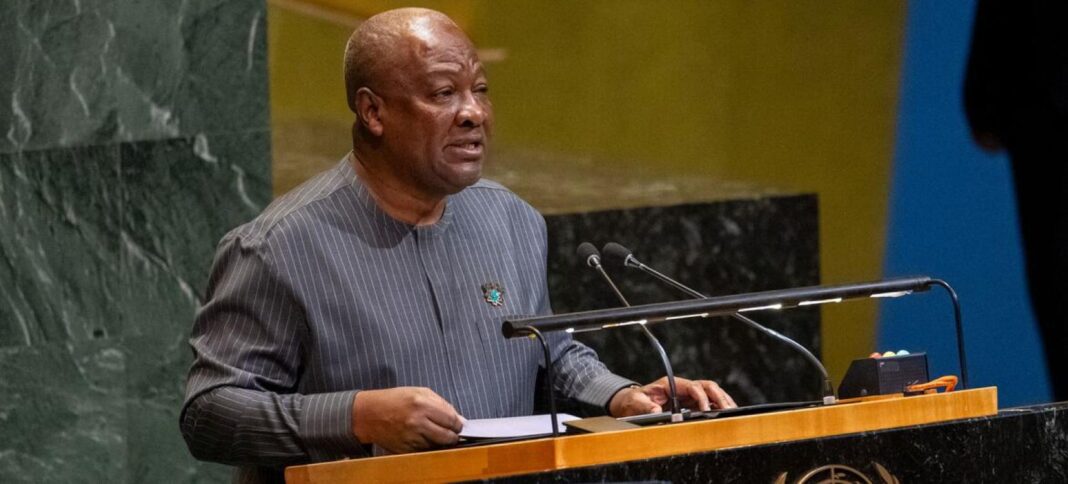
At the instance of a resolution proposed by Ghana on 25 March, 2026, the United Nations General Assembly voted to designate the Transatlantic Trafficking of Enslaved Africans and the system of race-based chattel enslavement as “the gravest crime against humanity.” 123 Member States voted in favour of UN Resolution A/80/L.48. The Ghana-led African advocates of the resolution hoped that its adoption would mark a historic shift in the international community’s engagement with the enduring legacies of slavery. Three countries—Argentina, Israel, and the United States—voted against it, and 52 abstained. In the 178-member chamber where the vote was conducted, approximately a third of the member states abstained from voting or voted against the draft resolution. For a moral dunk question, such as the incomparable historic descent to the very nadir of the human spirit that slavery represented, that was an embarrassing outcome. Most of those who abstained or voted against constitute the pivotal actors in the international system. The number of abstentions and the locations of the absenters within the global hierarchical order reveal a more critical dimension of the dominant alignment of sensibilities in the developed North. It reflected pervasive cynicism on the attempt of the collectivity of African leadership to continue to conveniently and falsely blame slavery for the unceasing woes of the continent. To be emphatic, Africa’s current situation is the outcome of its own irresponsibility. It is like Nigeria blaming every developed country for its internal woes, when our challenges are directly traceable to internal factors and forces.
A cursory view of the voting pattern reveals cynical politicking that is not unexpected at the United Nations. The Global South’s unconditional solidarity largely mobilized the 123 states that voted for the resolution. Among the “yes” voters are Arab states that still tolerate the treatment of blacks no better than enslaved people. In fact, Arabs were some of the earliest people to commodify black humanity as enslaved people to be exported as cargo out of Africa. Even the crusading African governments conveniently pretend that all is well, even when Arabs are known to dehumanize helpless black humanity who are forced by the policy of impoverishment of their governments to enslave themselves in Arab countries. Did any African government protest when reports emerged of Arab employers directly easing themselves into the mouths of their black servants that were forced open? Or, when it emerged that female black servants were transformed into family sexual enslaved people who were at the call and beck and call of Arab fathers and sons? Or, the indiscriminate beheadings of blacks in Arab states, often under dubious legal processes? These are the states that held their noses, closed their eyes, and voted to proclaim slavery “the gravest of crimes against humanity.” And then, what?
The Russian Federation voted for the resolution. Its international politics demanded it. That was imperative given Russia’s convenient politics of blaming the history of the West for Africa’s problems. This is essentially to validate its own strategic incursion into the African space. The rationalization of the Russian Federation is convenient and consistent in its perhaps hypocritical alignment with the dubious claim that the immovable throes of the enduring legacies of slavery permanently hold down Africa. Israel voted against, it can be speculated, because of the description of slavery as “the gravest crime against humanity.” Where does that description of slavery leave the holocaust in the implied hierarchical placement of the systemic attempt to wipe Jews from the surface of the Earth? (Don’t overread the paradox of the alliance of Benjamin Netanyahu and Donald Trump). That is, if there can be any justification to draw a comparison on the relativity of the unquantifiable gravity of the senseless evil of one strand of the human family against another. Then, just a relevant digression: How has Israel, founded as a reaction to the Holocaust, been able to consolidate its statehood while Africa continues to flounder? Why has Africa failed to mobilize its worldwide Diaspora effectively? Didn’t Barack Obama and Colin Powell mock Nigeria, the flagship state of global black humanity? There are fundamental questions that require black humanity to engage itself internally, rather than this endless shameful whining around international circuits with a running nose of dirty phlegm. As for the United States, it is doubtful that any of its past administrations would acquiesce to a resolution on reparations. What is certain is that, given the implacable racist underpinnings of policy under Donald Trump, there was no surprise at its “No” vote. As for the abstentions on the vote, many diverse reasons may be advanced. Most are substantively sympathetic to the idea that slavery was a gravely heinous evil, but found it politically inconvenient to vote in favour of the resolution. It is doubtful if this had to do with any fears of the economic implications of the non-binding General Assembly vote. The United Kingdom presents a classic example. A cursory reference to the speeches of abolitionists such as William Wilberforce confronts one with his most poignant statement to the parliament that slavery was “a great evil”. Britain had been indicted by the human articulators of the nation’s moral force, that it (Britain) was complicit in a commercial trade of human beings, heinous in its proportions. In an oration in 1789, William Wilberforce affirmed that:
When we consider the vastness of the continent of Africa; when we reflect how all other countries have for some centuries past been advancing in happiness and civilization; when we think how in this same period all improvement in Africa has been defeated by her intercourse with Britain; when we reflect that it is we ourselves that have degraded them to that wretched brutishness and barbarity which we now plead as the justification of our guilt; how the slave trade has enslaved their minds, blackened their character, and sunk them so low in the scale of animal beings that some think the apes are of a higher class, and fancy the orango-outang has given them the go-by.
The old slave nations that we seek to pillory are mere foils in our escapist strategy of denying our front role culpability in our affairs. These states know why we are engaged in it. Many of them had, for a long time, internalized the guilt before we woke up to this disingenuous initiative. In many respects, they have been making amends continuously. Britain began to make amends in its own way. In fact, the idea of reparation was first and long formulated, and galvanized humanitarian action in the United Kingdom. Belgium is waking up to its own historic catastrophic rule in the Congo, which is remembered for the decimation of the population. The Germans who experimented with mass human extermination first with the Herero and the Nama in the Namibia genocide before the Holocaust of Jews have taken responsibility for the historic guilt and, since then, without any external instigation, have been seeking to make amends. King Leopold cut the limbs of at least 10 per cent of the population of that permanently embattled land. France, fixated in its imperious national mindset, is learning its bitter lessons. Even the United States, a non-imperial WW II hegemon, under previous administrations, formulated policies that advanced our humanity, even if these were designed to advance strategic American imperatives. In effect, the world has changed in many fundamental ways. The constructive way forward for Africa should be to build enhanced capacity to advance its strategic interests autonomously. The rhetoric of reparation is unproductive other than as a mere ruse to cover the gross irresponsibility of a leadership devoid of empathy and vision for its own people. Of course, it is a winning strategy among the undiscerning aficionados of crass populism.
A first step in the rebirth of Africa does not lie in chasing shadows in a shameless public show of self-deceit on international fora. Africa looks bad in that tattered garment, whining when it should get serious about addressing its monumental deficits in public governance. Reparations must begin with corrupt African leaders restituting what they have stolen from the people. Africa has to formulate an impeccable code of responsibility in the management of state affairs. Let us begin our charity from home. Research estimates that Nigerian public officials stole more than $400 billion from state coffers since the 1980s, with much of the funds transferred to and retained in wealthy foreign countries. Just yesterday, a newspaper reported that in a surprising turn of events, a former aviation official was discharged from an alleged N2.5 billion fraud case. The decision comes after companies linked to her pleaded guilty and forfeited N1.98 billion to the Federal Government. Interestingly, the ruling struck out the charges against the former minister and her former aide. The day before, a Federal High Court sitting in Abuja ordered the final and permanent forfeiture of the sum of $13 million linked to a businesswoman and her Oceangate Engineering Oil & Gas Ltd, to the Federal Government. Every day before that, reports posted heart-numbing accounts of the hemorrhage of the public treasury.
Nigeria is not alone in this continental affliction. According to the BBC, Ghana’s former finance minister, Ken Ofori-Atta, is a fugitive from justice and is facing a public demand for accountability. In June 2025, he was placed on Interpol’s Red Notice list for allegedly using public office for personal gain. A Red Notice is not an arrest warrant but a request to police worldwide to detain someone pending extradition. Meanwhile, the President of Equatorial Guinea, Teodoro Obiang Nguema Mbasogo, has an estimated net worth of $600 million. This figure often represents the combined wealth of him and his family, which is largely derived from the country’s oil reserves.
So, under these circumstances, where is the rationale and the locus of locusts for reparations for Africa?
*Professor Ademola Araoye is a retired official of the United Nations and former Director of Abuja Leadership Center, a TETFUND Center of Excellence in Public Governance and Leadership at the University of Abuja. He is author of Sources of Conflict in the Post- Colonial African State (AWP, 2012).
This article was first published in thenewsnigera.com.ng