


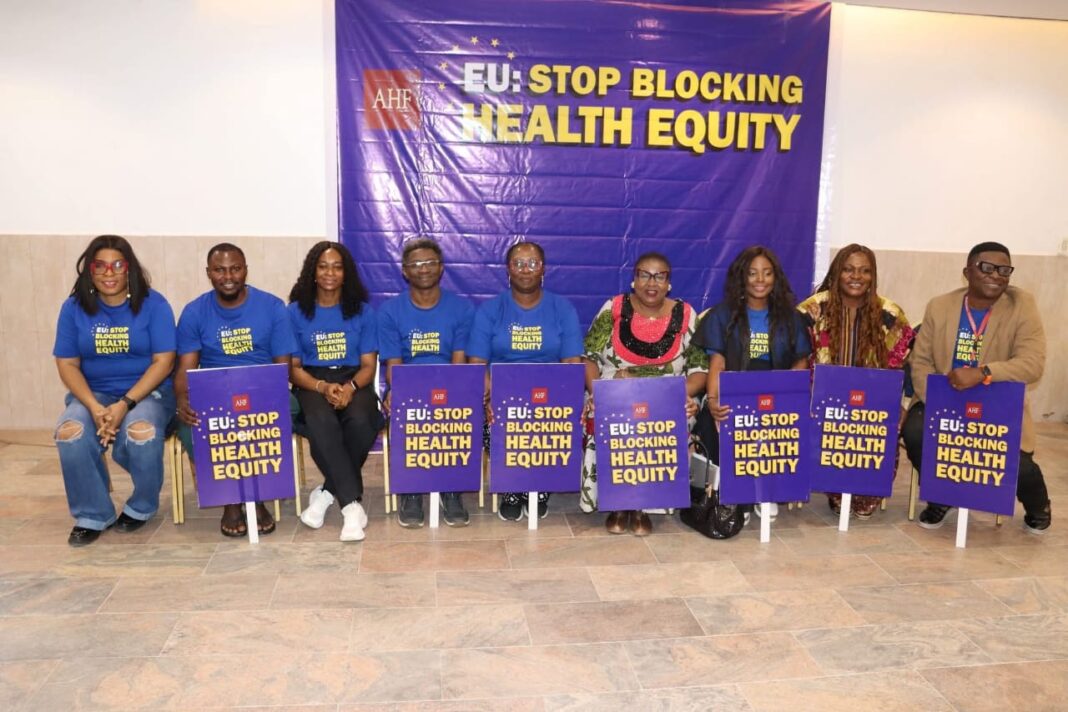

The AIDS Healthcare Foundation (AHF) Nigeria, alongside key stakeholders, has called on the European Union (EU) to support health equity in the ongoing negotiations for a global pandemic agreement, warning against a repeat of the inequalities witnessed during the COVID-19 crisis.
The appeal was made on Tuesday in Abuja during a press briefing on the World Health Organization (WHO) Pandemic Agreement and the Pathogen Access and Benefit-Sharing (PABS) Annex negotiations. The event was organised by AHF Nigeria in collaboration with other civil society organisations (CSOs).
Dr Echey Ijezie, Country Programme Director of AHF Nigeria, urged EU leaders to stop obstructing equity provisions and instead facilitate the conclusion of a fair and effective agreement.
He warned that a weak PABS Annex could lead to a recurrence of what he described as “vaccine apartheid,” as experienced during the COVID-19 pandemic, thereby placing all countries at risk.
“The EU must stop blocking equity and help finalise the agreement. A weak annex risks repeating the vaccine apartheid of COVID-19 while endangering all countries,” he said.
Ijezie emphasised the need for the EU to align its position with the principles of solidarity and fairness it publicly advocates. He called for support for mandatory benefit-sharing, legal certainty, and enforceable accountability measures within the agreement.
According to him, a strong PABS Annex is not merely symbolic but essential for saving lives.
He further outlined key concerns, stressing that the annex should not be adopted without robust equity provisions. Weak commitments, he noted, could perpetuate the inequities seen during the COVID-19 era.
Ijezie added that developing countries are demanding binding rules rather than voluntary arrangements, underscoring the importance of clear and enforceable obligations to build trust and ensure fairness in global health responses.
He also highlighted the pivotal role of the EU, noting that its position could either unlock progress in the negotiations or weaken the final outcome. Without equitable benefit-sharing, he warned, efforts by countries to strengthen regional production and achieve health sovereignty could be undermined.
He explained that advocacy efforts are focused on key EU actors because of the bloc’s central influence in the negotiations, adding that a shift in its stance could break the current deadlock and lead to a more equitable agreement.
Also speaking, Mr Romy Mum, President of Lawyers Alert, stressed that pandemic response mechanisms should not be commercialised at the expense of human lives. He called for justice and equity before the ratification of the agreement.
He noted that while pathogens are collected globally, access to resulting vaccines, drugs, and diagnostics often remains unequal.
“Pathogens are sourced from across the world, yet when vaccines and diagnostics are developed, access is not equitable. Licensing, distribution, and control are often concentrated in the Global North, leaving poorer countries behind.
“A pandemic does not respect borders or licensing regimes—it affects everyone. Therefore, no global framework should be signed unless the annex guarantees equitable access to medicines, diagnostics, and other benefits derived from globally sourced pathogens.”
Mr Martin Egbanubi, National Secretary of the Joint Health Sector Union (JOHESU) and General Secretary of the Nigerian Allied Union of Health Workers, emphasised the right of every citizen to access healthcare. He urged the government to prioritise public health and invest in local vaccine production to better manage future health emergencies.
“We must develop concrete strategies for tackling health emergencies. It is not something to be left to chance. The next pandemic may not be as forgiving, and our existing systems may not withstand the pressure,” he said.
Egbanubi also called on African countries to intensify advocacy efforts and invest in research and development to reduce reliance on external support.
Ms Gloria Asuqwo, a board member of the International Community of Women Living with HIV/AIDS in West Africa, stressed the importance of inclusivity in the negotiation process. She called for civil society organisations to have full access to discussions and relevant documents before the agreement is finalised.
“Equity, justice, and fairness must guide this process. For the PABS Annex to be adopted, all stakeholders must be meaningfully included and carried along,” she said.
In her remarks, Mrs Chizoba Ogbeche, Vice President (Zone D) of the Nigeria Association of Women Journalists (NAWOJ), reaffirmed the organisation’s commitment to promoting equity, inclusivity, diversity, and justice across all sectors.
Other participants at the event included representatives from the Network of People Living with HIV/AIDS in Nigeria (NEPWHAN), the Association of Women Living with HIV/AIDS in Nigeria (ASHWAN), the Association of Positive Youths Living with HIV/AIDS in Nigeria, and the Nigeria Network of Religious Leaders Living with or Personally Affected by HIV/AIDS (NINERELA+).