



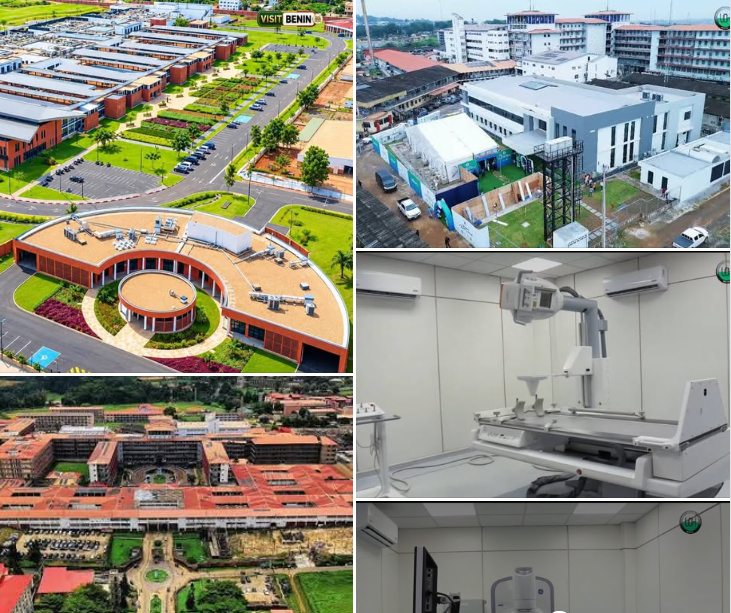

One week ago, the Nigerian government commissioned a specialised radio‑diagnosis unit and a cardiac catheterisation laboratory at the University College Hospital, Ibadan. It is one of 10 advanced diagnostic centres completed nationwide under a package of 16 major health projects, including six cancer centres, approved by President Bola Tinubu in February 2024. Benin Republic, by contrast, still lacks a fully operational, permanent cath lab. When coronary intervention is required, its citizens travel to Nigeria or elsewhere. This is one strand of a quiet but consequential modernisation effort meant to bring care closer to Nigerians and reduce the financial drain of medical tourism.
Yet this progress often struggles to survive the country’s digital mood. A familiar reflex takes over: the slightest foreign achievement becomes a prompt for Nigerians to disparage their own institutions. It is not always malice; sometimes it is simply habit.
A Facebook page called Visit Benin recently claimed that Benin Republic now hosts the largest and most advanced international teaching hospital in West Africa. The harshest replies came from Nigerians urging their leaders to learn from a neighbour they imagined to be miles ahead.
The Ritual of Miscomparison
It is the latest expression of a pattern on social media that has become almost liturgical. A Nigerian sees a gleaming new landmark in Accra or Kigali or Cotonou, and admiration quickly hardens into self‑reproach. The achievement of a neighbour becomes a stick with which to beat one’s own country. Evidence rarely enters the room. Old grievances do the heavy lifting.
This is how the claim about Benin’s International Hospital Centre of Calavi travelled. It was repeated with fervour, especially by Nigerians eager to confirm their bleakest assumptions. Few paused to check the numbers.
What the Numbers Say
Calavi is an achievement. It spans roughly 48,000 square metres and holds 434 beds. But “largest” is not a feeling. It is a measurement. The University College Hospital, Ibadan occupies close to 300,000 square metres and carries 1,445 beds. On land size and bed capacity, UCH is more than six times larger and over three times heavier in patient load. Even its 1957 starting point of 500 beds would outstrip Calavi today.
A Legacy Longer Than a Headline
But UCH’s significance is not merely quantitative. It was West Africa’s first teaching hospital, the institution that shaped the region’s medical education and trained the pioneers who carried it outward. It helped establish the West African College of Physicians and Surgeons. It performed Nigeria’s first fully indigenous open‑heart surgery in 1978. It launched the country’s first nuclear medicine service and its first palliative and hospice programme. In 2012, it opened sub‑Saharan Africa’s first purpose‑built geriatric centre.
Its newer chapters matter too. A liquid oxygen plant now feeds its critical wards. The Medserve Diagnostics Centre, built with the Nigeria Sovereign Investment Authority, houses advanced imaging and a cath lab that anchors Nigeria’s expanding interventional cardiology footprint. Three cancer centres are already operational, with three more underway. Benin Republic’s cardiology, anchored at CNHU‑HKM, remains limited to basic diagnostics and pacemaker implantation; complex catheter‑based interventions still require travel abroad. Even UCH’s house officers now live in refurbished studio residences that reflect a modern clinical ecosystem.
None of this is glamorous in the way a ribbon‑cutting is glamorous. But hospitals are built in increments: oxygen plants, imaging suites, training pipelines, specialist programmes. UCH has been accumulating them for nearly 70 years.
Progress Does Not Require Diminishing a Rival
None of this diminishes Benin’s achievement. A modern 400‑plus‑bed hospital is a triumph for any nation. The problem is not the hospital. It is the superlative draped over it, and the eagerness of some Nigerians to weaponise that superlative against their own country without first checking the records.
Nigeria’s health sector has deep challenges, but it also has institutions that have carried the region for decades and continue to modernise in ways that rarely make headlines. Progress in Cotonou does not require erasing Ibadan. And disappointment in Nigeria does not require abandoning fact.
The numbers are there. The history is there. The progress is there.
The records, when kept honestly, tell a fuller story than grievance ever will.