



Introduction
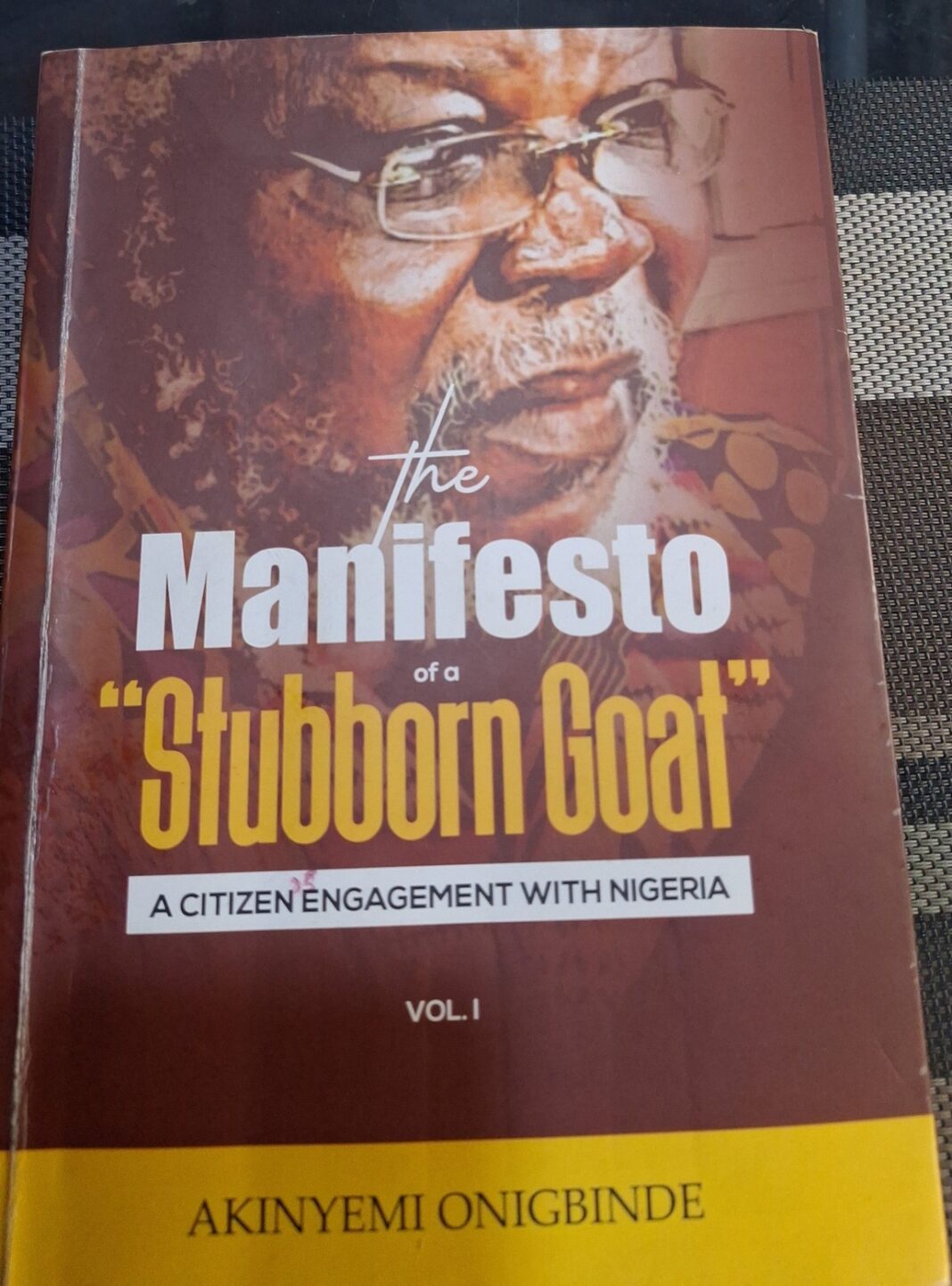
What does it mean to persist in speaking when a society appears locked in repetition, when crises recur with such regularity that they no longer provoke surprise, and when promises are recycled with barely concealed impatience? This question lies at the heart of The Manifesto of a Stubborn Goat, a two volume collection of opinion essays written over the course of roughly four decades. In these volumes, Professor Akinyemi Onigbinde approaches the Nigerian experience not as a closed historical episode, but as an unfinished moral and political project, one that continues to demand interrogation rather than resignation.
From the outset, one sees a work animated by a concern for the ethical foundations of public life. Politics is treated here not primarily as electoral competition or mere institutional procedure, but as lived reality with profound consequences. Politics, especially here in Nigeria and according to the book, verges on how power is exercised, how injustice is justified, how institutions decay, and how citizens are gradually socialised into endurance rather than resistance. The author writes with the conviction that ideas are public acts and that writing itself is a form of civic responsibility. In this sense, the book belongs firmly within the tradition of engaged public intellectualism, where scholarship refuses isolation from society and accepts accountability to it.
The context from which this work emerges is crucial to its form and force. Informed by student activism, journalism, and philosophical reflection, the author writes simultaneously as participant and observer. The essays do not pretend to neutrality or methodological detachment. They are interventions, produced in moments of tension and crisis, and preserved largely as they were written. This refusal of retrospective sanitisation is itself instructive. It compels readers to confront how arguments age, how warnings echo across time, and how history responds, or fails to respond, to sustained critique.
What gives the book its unsettling relevance is continuity. Many of the issues addressed governance failure, repression of dissent, the crisis of public education, elite hypocrisy, insecurity, and the shrinking space for civic freedom remain central to Nigeria’s present condition. What has often changed is not the nature of the problem, but its intensity, its language, or its administrative form. The persistence of these conditions invites reflection not only on the state, but on the limits of reform, memory, and political learning. Silence, forgetfulness, and accommodation, the book insists, are themselves forms of complicity.
The Stubborn Goat as Ethical Figure
The metaphor of the stubborn goat, a cognomen bestowed by a disciplinarian mother, now prophetic in hindsight, is not incidental to this work. It is its moral centre. In many African moral traditions, the stubborn goat is not a symbol of foolishness. It is the animal that refuses to be dragged quietly to slaughter. It plants its feet. It resists direction. It slows violence, even when escape is uncertain. That pause is its ethical significance.
Across these volumes, the author deliberately assumes this posture. In moments of national euphoria, policy announcements, electoral transitions, or reformist rhetoric, he repeatedly refuses to move with the crowd. He asks questions when optimism demands silence. He insists on structural analysis when slogans dominate. This is not contrarianism for its own sake. It is the conviction that unexamined hope can be as dangerous as despair.
The stubborn goat therefore becomes a model of citizenship. It represents refusal without nihilism, persistence without illusion, and critique without withdrawal. It insists that societies collapse not only because of bad leaders, but because too many citizens eventually agree to move in the wrong direction quietly.
Crisis as Familiarity and the Politics of Endurance
There is a point at which a nation’s crisis ceases to shock its citizens, not because it has been resolved, but because it has become familiar. The Manifesto of a Stubborn Goat begins its intervention precisely from within this troubling familiarity. Rather than asking only what has gone wrong, the book presses a more unsettling question: how has wrongness become sustainable, even predictable?
Across the essays, the author gathers a wide range of disturbances governance breakdowns, the erosion of public education, assaults on press freedom, elite moral compromise, judicial inconsistency, ethnic manipulation, and the shrinking space for dissent. These are not treated as isolated malfunctions. They are presented as interconnected symptoms of a deeper historical malaise. What the author persistently interrogates is endurance. How does a society learn to live with what ought to be unbearable? How does repetition itself become a political technology?
This question acquires particular urgency when situated within contemporary Nigerian realities. Economic precarity deepens. Youth disillusionment spreads. Institutions decay with little resistance. Protest is criminalised. State power is increasingly deployed against citizens rather than in their defence. In this climate of spiralling inflation, mass emigration, declining trust in elections, and eroding legitimacy, many of the essays no longer read as warnings. They read as descriptions.
An essay written years ago on the repeated closure of public universities illustrates this painfully. The author treats universities not merely as educational institutions, but as moral and civic barometers. Their collapse signals a broader social abandonment of reason, merit, and long term thinking. Today, that argument requires no embellishment. It has become lived reality. That this condition was anticipated decades earlier is less a testament to foresight than an indictment of a political culture persistently unwilling to learn from critique.
Power, Silence, and the Rewarding of Violence
One of the most disturbing arguments in the book concerns the moral economy of the Nigerian state. Again and again, the author shows how violence attracts attention while restraint is ignored or punished. This argument reaches its sharpest expression in essays reflecting on the execution of Ken Saro Wiwa and the Ogoni Nine.
The author insists that the crime was not only the execution itself, but the lesson it taught. Nonviolent dissent was met with death, while later armed insurgencies were met with negotiation, amnesty, and reward. In this inversion, the state taught its citizens that moral courage was naive and that violence was rational.
The later decision to offer a posthumous pardon rather than exoneration is subjected to similarly sharp critique. A pardon presupposes guilt. It seeks closure without truth. The author argues convincingly that symbolic gestures without justice do not heal historical wounds. They merely manage memory.
Placed in comparative perspective, this pattern is not unique to Nigeria. Across Latin America, Eastern Europe, and parts of Africa, regimes have silenced principled dissenters only to rehabilitate them symbolically when denial becomes politically costly. The stubborn goat refuses this arrangement. It insists that justice aestheticised is not justice delivered.
Insecurity and the Collapse of Trust
In the later essays, insecurity emerges as the defining condition of national life. Not only physical insecurity, but existential insecurity. The inability to plan, to trust institutions, or to imagine continuity. The author treats this not simply as a failure of arms or intelligence, but as a collapse of the social contract.
Communities are attacked. Perpetrators are rarely held accountable. Official responses are evasive or contradictory. Over time, fear becomes ordinary and survival becomes private. Citizenship weakens. Patriotism loses moral content.
The author insists that insecurity is not merely a technical problem. It is a moral one. A state that cannot protect its citizens forfeits its claim to unquestioned loyalty. The stubborn goat refuses to celebrate unity when the basic conditions of safety and dignity are absent.
Globally, this diagnosis resonates. From parts of Latin America to South Asia, states that tolerate chronic insecurity while demanding obedience produce fragile democracies. Nigeria, as these essays show, is part of this broader pattern.
Economic Policy and the Ethics of Suffering
The essays on economic policy are among the most accessible in the volumes. Writing on fuel subsidy removal, currency devaluation, and austerity, the author refuses technocratic abstraction. He asks simple but profound questions. Who bears the cost? Who benefits? Who decides?
In one essay responding to subsidy removal, he challenges the claim that hardship is temporary and necessary. Suffering, he notes, has become permanent, while relief is endlessly postponed. Policies presented as inevitable are revealed as choices that systematically transfer pain downward.
This critique places the book firmly within a global conversation. From Argentina to Greece to Ghana, similar policies have produced predictable social consequences. What The Manifesto of a Stubborn Goat adds is moral clarity. Economic policy is never neutral. It distributes suffering and opportunity. The stubborn goat resists the language of inevitability and insists on accountability.
Institutions, Leadership, and the Myth of Change
Throughout the volumes, leadership is examined without sentimentality. The author avoids reducing Nigeria’s troubles to personalities. Instead, he exposes institutional decay. Nepotism, selective law enforcement, and rhetorical governance recur across administrations of different ideological colours.
One recurring insight is the myth of novelty. Each new government presents itself as a rupture from the past. The author patiently demonstrates continuity beneath changing slogans. This enforced amnesia prevents cumulative accountability. Citizens are repeatedly invited to forget yesterday’s betrayals in order to believe today’s promises.
Here, the stubborn goat functions as historian. It refuses to forget. It insists on memory as a political act.
Limits, Gaps, and Productive Incompleteness
A serious engagement with this work requires dialogue, not mere reverence. At times, society appears in parts of the work as a relatively unified moral subject confronting a corrupt elite. However, contemporary realities suggest more differentiated experiences. Women disproportionately absorb care burdens, while young people are forced to navigate prolonged unemployment and migration pressures. Informal workers operate without protection and slavish wages, while communities that are exposed to perennial environmental degradation bear costs they did not generate.
Still, these are not failures of concern so much as historical limits. Many essays were written before these dynamics fully crystallised. The ethical framework of the book is broad enough to accommodate them. What it invites therefore, is an extension, not necessarily correction.
Similarly, the author thrives at ethical diagnosis, but is cautious about reformative blueprints. This gap appears obvious, but a sympathetic reading will also suggest that the exercise of restraint in prescribing solutions is an act of intellectual honesty. Such epistemic humility leaves readers with the responsibility to figure out solutions, rather than consume prepared prescriptions. The stubborn goat does not offer shortcuts. It demands serious civic engagement.
Conclusion: The Courage to Remain Present
The Manifesto of a Stubborn Goat is not a comfortable book. It does not flatter its audience, and neither does it promise redemption. It offers something rarer and more demanding: presence. The decision to remain intellectually and morally present in a society that often rewards withdrawal in a perpetual season of anomie.
It is also a testament to ethical refusal. The refusal to normalise injustice. The refusal to forget. The refusal to retreat into the mode of personal, opportunistic survival. In an age of fragmented attention and performative outrage, this book reminds us that nation-building is an unfinished moral project. It demands memory, courage, and sustained engagement.
For Nigeria’s rapidly diminishing class of public intellectuals, the book is a reminder that silence in times of moral crisis is itself a political choice, which at the very best, is nothing but passive complicity. It calls on them to recover intellectual courage, historical memory, and ethical consistency in ways that stimulate resistance to the temptations that come on account of proximity to seductive political power. Above all, it affirms that sustained, principled engagement with society, even when ignored or costly, remains a vital civic responsibility.
For contemporary readers its value lies not in the provision of settled answers, but in the responsibility it imposes on us all to continually interrogate this postcolonial state as defined by the ruling elites, and the implications of that definition for our lives as citizens and victims. There is no guarantee that we will be able to save the nation, especially at a time when impunity has plateaued, and state capture is now celebrated as statecraft. But if we are to have any hope for redemption, there must be a critical mass of citizens who are willing to become stubborn goats.
A very hearty birthday to the original stubborn goat.
Thank you.
Adeolu Oyekan
Research Associate
Decoloniality Research Group
Department of Philosophy
University of Pretoria
Adjunct Researcher
African Studies Center
Kansas State University