


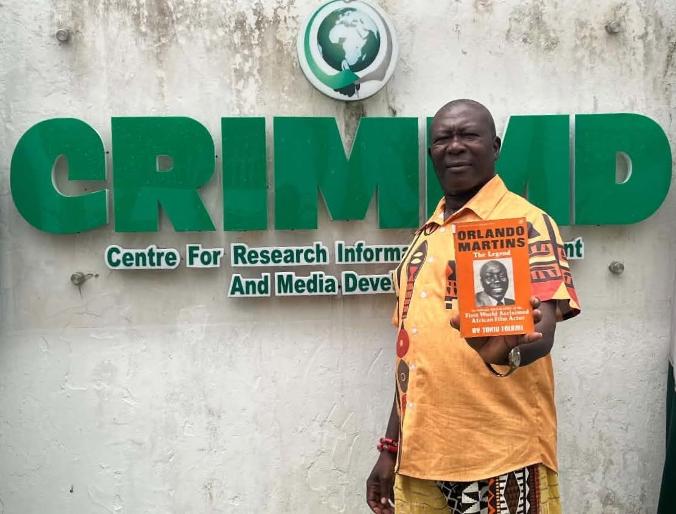

At the CRIMMD Museum and Archive, we have this book dated 1983. I bought it in 1985, titled ‘Orlando Martins – The Legend: First World Acclaimed African Film Actor by Takiu Folami.
I have followed with keen interest the controversy over an interview granted by legend Pete Edochie, and having read the book in my hand in 1985, this is my take.
Orlando Martins and Pete Edochie are both towering figures in African cinema, though they emerged in very different eras and contexts.
Orlando Martins was a true pioneer, breaking ground internationally as one of Britain’s most prominent Black actors in the 1940’s, a rare feat for the time. His career spanned continents and mediums, from circus performer to stage and screen, and he earned recognition not just in the UK but globally. His role in Things Fall Apart (1970) as Obierika came at the tail end of a long, trailblazing journey that helped open doors for future generations.
Pete Edochie, born decades later, became a household name in Nigeria and beyond through his powerful portrayal of Okonkwo in the 1987 NTA adaptation of Things Fall Apart. While Martins was active in a time when African voices were scarce in global media, Edochie rose during a wave of Nigerian cultural assertion, becoming a symbol of national pride and artistic excellence.
So while Martins paved the way internationally, Edochie became a national legend, bringing African stories to African audiences with unmatched depth. Both are icons, Martins as a pathfinder, Edochie as a cultural anchor. And you’re spot on: greatness isn’t about who came first, but the impact one makes in their moment.
Let’s study their profiles:
Orlando Martins was born on 8 December 1899 and lived until 25 September 1985), he was a pioneering Yoruba Nigerian film and stage actor. In the late 1940s, he was one of Britain’s most prominent and leading black actors, and in a poll conducted in 1947, he was listed among Britain’s top 15 favourite actors.
In 1923, Sanger’s Circus wanted to have someone to display their pythons; Martins took the part, starting his performing career in the circus. He also worked as a wrestler (known as “Black Butcher Johnson”).
He made his debut in If Youth but became known in 1926. In the 1930s, he went into acting on the London stage, playing Boukman in Toussaint Louverture: The Story of the Only Successful Slave Revolt in History, a 1936 drama by C. L. R. James that starred African-American actor Paul Robeson, with whom Martins had featured in the 1935 film Sanders of the River.
After the war, Martins had film roles in The Man from Morocco (1945) and in Men of Two Worlds (1946), alongside Robert Adams, becoming a sought-after character actor.
He appears in the 1949 film The Hasty Heart (starring Ronald Reagan and Patricia Neal), playing the African soldier Blossom, which role Martins also undertook in the stage production. In the 1950’s he made other appearances on the London stage, including in adaptations of Cry, the Beloved Country (Trafalgar Square Theatre, 1954), and The Member of the Wedding (Royal Court Theatre, 1957), before returning to Lagos in 1959. He subsequently took roles in such films as Killers of Kilimanjaro (1960), Call Me Bwana (1963), Mister Moses (1965), and Kongi’s Harvest (1970, Wole Soyinka’s adaptation of his play of the same name).
His final film role was the character of Obierika in the film adaptation of Things Fall Apart, which was produced in Nigeria in 1970. The executive producer was Francis Oladele, who established Calpenny-Nigeria Films Limited in 1965 – the first private film production company in Nigeria – with an intent to provide a platform for artistic expression more profoundly.
Chief Pete Edochie was born on 7 March 1947. He studied at the School of Journalism and Television in England. He rose to prominence in the 1980’s with his portrayal of Okonkwo in a Nigerian Television Authority adaptation of Chinua Achebe’s novel Things Fall Apart. He began his career as an administrator and broadcaster and later became a leading actor.
He began his acting career at the age of 15 in 1962, dramatising aspects of The Merchant of Venice by William Shakespeare at St. John’s College in Kaduna. Five years later, he got into radio broadcasting in 1967 at the age of 20 as a junior programs assistant, after which he was elevated to the level of a director. He was director of programs but doubled sometimes as Deputy Managing Director and occasionally acting as Managing Director. He featured in Things Fall Apart and had won an International Award.
Pete Edochie and Orlando Matins are both great actors; Orlando was acting long before Pete was born. Pete has the right to say he has no role model, because role models are not determined by age or who came first, but rather a role model is someone whose actions, success, or personal qualities inspire others to follow or imitate them. If he has no one he is imitating, then he is right.
*Raphael James is the Director General of the Center for Research, Information, and Media Development (CRIMMD).