


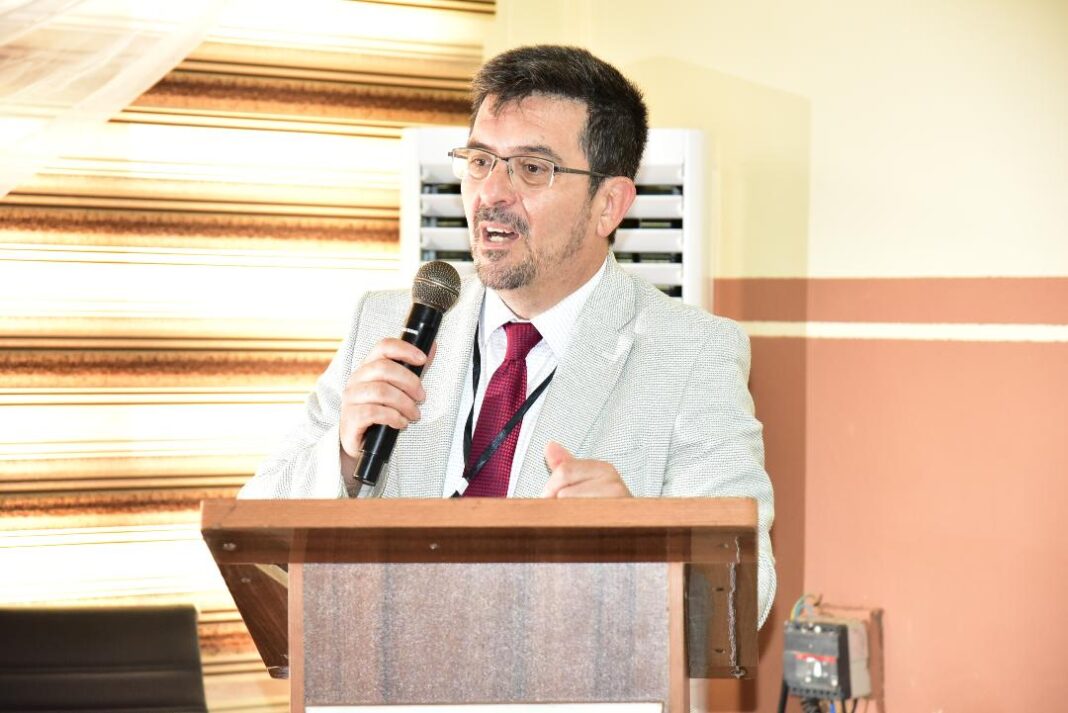

Experts at the 5th African Symposium on Big Data, Analytics and Machine Intelligence, held at the Federal University of Technology, Akure (FUTA), have prescribed the use of AI and other emerging technological and digital tools to build safer cities and provide sustainable solutions to societal challenges.
Leading discussions at the symposium, which held from Monday, June 15 to Saturday, June 20, 2026, under the theme, “AI for Smart and Sustainable Solutions Across Sciences and Societies,” Vice-Rector of Karabük University, Turkey, Professor Rakip Karas, in a lecture titled “AI for Smart and Sustainable Systems,” explained how artificial intelligence and advanced mapping technologies can be used to build smarter, safer, and more sustainable cities. He showed how AI can power systems that guide people to safety during emergencies, improve traffic flow and parking, and help predict forest fires before they spread. He also demonstrated how these tools can detect buildings and roads from satellite images and even identify health issues such as parasites in medical samples in real time.
Professor Karas emphasized that these technologies are not just ideas but practical tools already being tested, and that by combining data from sensors, satellites, and digital maps, cities can make better decisions on transportation, disaster response, infrastructure planning, and public health. His message was that when AI is applied to geospatial data, it helps cities become more resilient and improves everyday life for citizens.
Turkish scholar, Dr. Caner Ozcan, who spoke on “Machine Learning Across Disciplines,” described big data as the fuel and machine learning as the engine that turns it into useful insights and predictions. He explained that modern AI combines three core tools: big data, which handles huge volumes of information from different sources; machine learning, which learns patterns to make decisions without being told every step; and deep learning, which uses layered systems to understand complex data such as images, audio, and text. He showed how computer vision applies these technologies to interpret X-rays, satellite images, and other visual data. He stressed that building AI literacy for future educators is equally important, as democratizing AI knowledge helps develop critical skills needed for the next generation.
Speaking during the event, FUTA Vice-Chancellor, Professor Adenike Oladiji, represented by the Deputy Vice-Chancellor (Development), Professor Sunday Oluyamo, noted that we are living in an era where data has become one of the world’s most valuable resources. She observed that artificial intelligence is transforming key sectors, including security, agriculture, education, finance, governance, environmental management, and industry, creating new opportunities for innovation and development across the continent. The Vice-Chancellor stressed that technology alone is not enough. The challenge before Africa and the Global South, she stated, is ensuring that these technologies are developed and deployed responsibly, inclusively, and sustainably to address unique societal needs. This requires building indigenous capacity, strengthening digital infrastructure, promoting ethical AI, and ensuring that no community is left behind in the digital transformation journey.
The Dean, School of Computing, FUTA, Professor Boniface Alese, said artificial intelligence is already here and changing everyday life. From diagnosing diseases to predicting crop yields and building language models for Yoruba, Igbo, Hausa, and other African languages, AI, he said, is moving from theory to practice. He warned that Africa faces two paths: build the infrastructure and skills needed to create its own solutions, or remain consumers of systems trained on foreign data that do not reflect local realities.
Speaking at the event, Professor Emile Chimusa, Professor of Bioinformatics and Computational Biology at Northumbria University, United Kingdom, addressed the topic, “Advancement in Bioinformatics: Geopolitical Footprints on African Health Sciences.” He explained that bioinformatics brings together biology, computer science, advanced AI, and data analysis, and that the last decade has seen rapid growth in technology and computation, pushing the field forward.
Professor Dennis Mwighusa, Executive Director of the African Research Institute of AI in Tanzania, spoke on “Responsible and Data-Driven AI for Sustainable Development in Africa: Opportunities, Governance and Innovation Pathways,” under the wider event theme, “Data-Driven AI for Sustainable Impact: From Research to Real-World Solutions in the Global South.” He argued that Africa’s sustainable development depends on AI that is built responsibly and grounded in local data. He emphasized that AI can have a sustainable impact when it is African-led, well-governed, and designed to solve problems on the ground.
Speaking at the event, the Organising Chair of the symposium, Professor Bolanle Ojokoh, noted that universities across Nigeria are applying data science, analytics, and artificial intelligence to address real-world healthcare challenges. She described the TYAN International Thematic Workshop series as a platform that structures interdisciplinary collaboration and strengthens the participation of institutions across the Global South. She emphasized that the symposium serves as a forum for learning, mentorship, and exposure, particularly for graduate students participating as presenters and attendees. She expressed appreciation to the Vice-Chancellor, Professor Adenike Oladiji, for her leadership and commitment to research excellence, innovation, and international collaboration.
The symposium, which also incorporated the 22nd TYAN International Thematic Workshop, featured participation from the Oregon Institute of Technology, USA; Karabük University, Turkey; and The World Academy of Sciences (TWAS) Young Affiliates Network (TYAN). It was attended by scholars from Nigeria, Turkey, Tanzania, Egypt, Singapore, the Democratic Republic of Congo, the United States of America, Tunisia, the United Kingdom, and Australia. The event was dedicated to exploring how AI connects disciplines to solve real-world problems, positioning data and artificial intelligence as critical drivers of innovation across Africa and the Global South.